
The single best move you can make in a DSCR loan submission is sending a reconciled file: verified rent support, a credible appraisal path, clear entity authority, and proof of funds, all cross-checked against each other before the lender ever sees them. Most lenders look for a debt service coverage ratio near 1.25, though a lower ratio can still work with a remediation plan such as reduced leverage. Numbers that do not match across documents, and unexplained outliers without a short cover letter, are what turn a clean file into a stack of conditions.
TL;DR:
- Most lenders target a DSCR near 1.25, calculated from qualifying rent after deductions divided by annual debt service, including taxes, insurance, and association dues.
- Use signed leases, current rent rolls, or appraiser rent comparisons to support income; owner estimates rarely satisfy underwriting without a clearly labeled comparable rent study.
- Before submission, reconcile rent roll totals with bank deposits, confirm lease dates and occupancy, and explain appraisal differences, unusual deposits, related party leases, or missing returns.
- If the ratio falls short, consider a larger reserve cushion, a lower loan amount, or an interest rate buydown; reduced leverage may also help.
- Straightforward files often reach clear to close in three to five weeks; order appraisal and title work at submission, since both often set the pace.
Table of Contents
- What to confirm before you apply
- How to calculate DSCR and estimate qualifying rent
- DSCR loan document checklist
- Reconcile the file before submission
- Submission steps and underwriting: what happens after you hit send
- Timeline and common delays
- How BrokersConnect helps package and track DSCR submissions
- Why a checklist-first approach saves deals
- Try BrokersConnect to organize your next DSCR submission
- FAQ
- Sources
What to confirm before you apply
Before you package anything, confirm the deal actually fits the box you are aiming for. Start with the transaction type: a purchase, a rate and term refinance, or a cash-out refinance each carry different seasoning rules, reserve requirements, and sometimes different maximum leverage. Submitting a cash-out request to a lender that only wants to see stabilized purchases wastes everyone's time.
Next, check whether the property type is actually eligible. Single-family rentals, small multifamily, short-term rentals, and mixed-use buildings do not all qualify with every lender, and occupancy rules matter too. A property with an owner-occupied unit or a recent primary-residence history can disqualify a deal that otherwise looks strong on paper.
Run a quick internal pre-qualification before you go further:
- Confirm the borrower's credit profile meets the lender's general range for the program.
- Estimate loan-to-value against a realistic valuation, not an optimistic one.
- Check that reserve requirements (often expressed in months of payments) are achievable with the funds on hand.
Finally, classify the loan correctly as business-purpose rather than consumer-purpose, since that distinction drives which disclosures apply. Regulation Z's business-purpose exemption under §1026.3(h) relieves certain investment-property loans from specific consumer disclosures, but creditors still have to retain evidence supporting that classification. Misclassifying a loan, even unintentionally, creates compliance problems that surface during underwriting, not before.
How to calculate DSCR and estimate qualifying rent
DSCR math is simple once you know which income a lender will actually count. Start with gross rental income from a signed lease or current rent roll, then subtract items the lender excludes, such as utilities paid by the landlord or vacancy allowances the program requires. What remains is effective gross income. Dividing that figure by the annual debt service (principal and interest, plus taxes, insurance, and association dues where applicable) gives you the ratio.
Say a rental property generates $2,400 a month in verified rent, or $28,800 a year. Annual debt service, including taxes and insurance, comes to $23,000. Dividing $28,800 by $23,000 produces a DSCR of 1.25, right at the threshold many lenders use as their standard cutoff.
Lenders generally accept signed leases, current rent rolls, or a third-party rent comparison such as an appraiser's Form 1007 as qualifying income sources. Owner estimates alone rarely satisfy underwriting unless they are labeled clearly as such and backed by a comparable rent study.
When a deal lands just under the target ratio, you have options besides walking away: proposing a larger reserve cushion, requesting a slightly lower loan amount, or presenting the file with an interest-rate buydown that improves the debt service side of the equation.

DSCR loan document checklist
A lender-ready file groups cleanly into five categories. Pulling these together before submission, rather than scrambling after the first round of conditions, is what separates a fast close from a stalled one.
- Borrower and guarantor: government ID, signed credit authorization, two to three months of personal bank statements, and a schedule of real estate owned.
- Entity documents: articles of organization or incorporation, operating agreement or bylaws, a resolution authorizing the loan, EIN confirmation, and a signed authority letter naming who can execute on the entity's behalf.
- Property documents: current leases, a rent roll, a recent profit and loss statement where one exists, a property inspection report, insurance declarations page, and the most recent property tax bill.
- Valuation support: the appraisal order confirmation, market rent comparables, and a short reconciliation showing how the rent roll lines up with appraised market rent.
- Funds and liquidity: source-of-funds documentation for the down payment, proof of earnest money deposit, two to three months of reserves in a liquid account, and wiring instructions once the file nears closing.
Freddie Mac's seller and servicer guidance for small balance loans is a useful reference point here: it requires specific reports and supporting documentation before a purchase commitment is issued, which mirrors the discipline DSCR lenders expect even outside agency programs, as outlined in its multifamily guide. Our loan document checklist for CRE brokers walks through a downloadable version of this same structure.
Reconcile the file before submission
Before anything goes to a lender, cross-check your own numbers. Rent roll totals should match actual bank deposits, and lease start and end dates should align with what the borrower claims about occupancy. An appraiser's rent conclusion that differs meaningfully from the submitted rent roll needs a short, specific explanation rather than silence.
Write brief explanation letters for anything that looks unusual: a large or irregular deposit, a lease between related parties, or a missing tax return for a newer entity. One paragraph stating the fact and the reason is usually enough.
Common red flags worth fixing before submission include a mismatch between the title-holding entity and the borrowing entity, deposits that do not trace to a known source, and leases expiring within a few months of closing. Each one is fixable with a document or a letter if you catch it early.
Submission steps and underwriting: what happens after you hit send
Once a file goes in, most DSCR lenders follow a similar sequence: intake and initial file review, credit and desk underwriting, appraisal and property inspection, a conditions list, and then clear-to-close. Ability-to-repay requirements under the Truth in Lending Act call for a reasonable, documented determination that the obligation can be serviced, and lenders retain that evidence long after closing, per the CFPB's ability-to-repay rule.

Underwriters re-check more than just the DSCR math. Title work, insurance coverage adequacy, entity authority documents, and in some cases environmental concerns on commercial-adjacent properties all get a second look.
When conditions come back, triage them. Respond to quick wins first, a missing signature page or a clearer bank statement copy, so the file keeps moving while you gather anything that takes longer, like a corrected entity resolution. If a condition seems to misread the file or conflicts with an earlier approval term, escalate directly to the underwriter or sponsor contact rather than letting it sit in a queue.
Timeline and common delays
A straightforward DSCR file often moves from submission to clear-to-close within three to five weeks, though appraisal turnaround and title work frequently set the real pace rather than underwriting itself. Complex leases, incomplete entity documentation, and slow title searches are the most frequent bottlenecks.
Ordering the appraisal and title commitment the same week you submit, rather than waiting for a conditional approval, shaves meaningful time off the back end. An insurance quote requested early avoids a last-minute scramble before closing.
How BrokersConnect helps package and track DSCR submissions
Centralizing lender matching, document storage, and condition tracking in one place cuts down on the duplicated requests that slow DSCR files. The platform pairs deal scenarios with lenders and keeps the document vault and condition list attached to the same deal record, so nothing gets re-requested because it was buried in an email thread.
Why a checklist-first approach saves deals
Underwriters ask the questions a messy file invites. Anticipating those questions, rent support that matches the appraisal, an entity letter that matches the title, a deposit that has a one-line explanation, is the difference between a file that closes on schedule and one that drags through three rounds of conditions. Talk to your lender contact early, before submission, not after the first condition list arrives.
— Theron
Try BrokersConnect to organize your next DSCR submission
Packaging a clean DSCR file takes real effort when you are juggling lender lists, document folders, and condition emails across several deals at once. A platform that brings lender matching, a document vault, and condition tracking into a single deal record helps keep your file reconciled from first submission through clear-to-close.
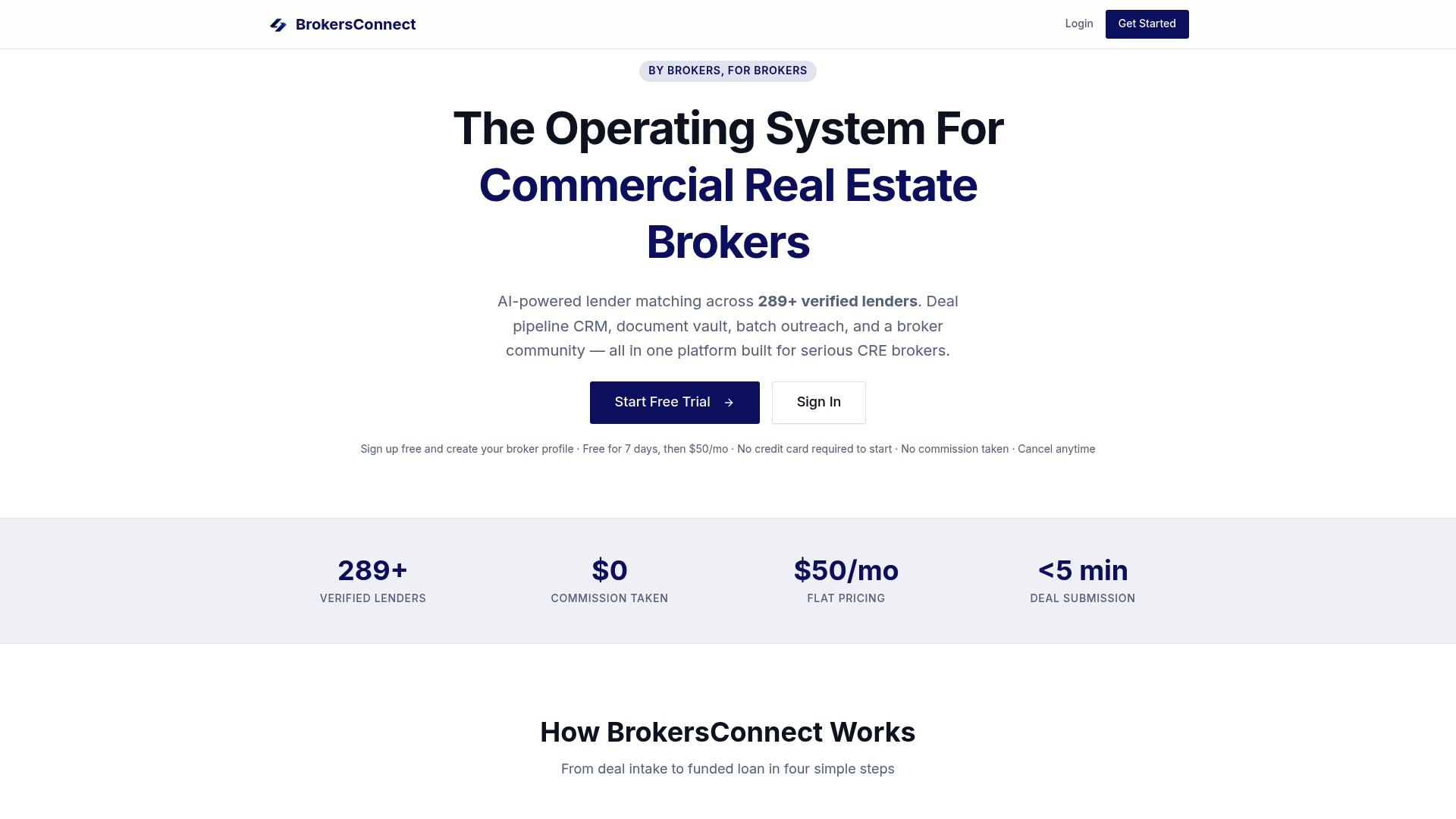
BrokersConnect matches deal scenarios against a database of 289 verified lenders covering DSCR, bridge, and multifamily financing, replacing cold-call lender searches with instant matching based on property type, leverage, and credit profile.
- Lender matching runs on property type, loan amount, and credit profile in one search.
- A shared document vault keeps borrower, entity, and property files attached to the deal.
- Condition tracking shows what is outstanding without digging through email threads.
Start a free trial at BrokersConnect for a flat $50 a month, with no commission on deals you close.
FAQ
What documentation is required for a DSCR loan?
A complete file typically includes borrower identification and bank statements, entity formation and authority documents, current leases and a rent roll, an appraisal with rent comparables, and proof of liquid reserves. Lenders also expect insurance declarations and a recent property tax bill to confirm carrying costs.
Do DSCR loans require 20% down?
Down payment requirements vary by lender and leverage tier rather than following one fixed number, so check the specific program's loan-to-value limits before assuming a figure. Lower leverage requests generally face fewer conditions and a smoother path through underwriting.
What is the process of a DSCR loan?
The process moves through intake and initial review, credit and desk underwriting, appraisal and inspection, a conditions list, and finally clear-to-close. Reconciling your rent roll, appraisal, and entity documents before submission reduces how many conditions come back in that middle stage.
How long does it take for a DSCR loan to be approved?
Many straightforward DSCR files move from submission to clear-to-close in three to five weeks, with appraisal turnaround and title work usually setting the pace rather than underwriting review itself. Ordering the appraisal and title commitment early, right at submission, helps keep that timeline on track.
Sources
- § 1026.3 Exempt transactions. | Consumer Financial Protection Bureau
- Ability-to-Repay and Qualified Mortgage Standards under the Truth in Lending Act