
There is no single federal license for commercial mortgage or commercial loan brokers. Whether you need one depends on the state where the deal sits, what the loan is secured by, how you are paid and what you actually do on the file. Some states require a dedicated commercial license, some route you to a real estate broker license, and some leave commercial brokering unlicensed. This guide shows how to sort your own situation, with state examples, and how to keep that check from slowing down your deal flow.
TL;DR
- No nationwide commercial broker license exists. Federal law does not generally require a banking license for entities extending commercial credit, but some states license commercial lenders and brokers.
- Four things decide your answer: the product, the borrower's location, how you are paid and what you do (lead generation, negotiating or placing).
- Arizona, California, Texas (for commercial sales-based financing) and others have specific rules. Vermont and Illinois exclude commercial loans from their mortgage broker licenses.
- Check every deal's state against the regulator and the MBA's state resource before you take a fee. Build that check into your file workflow.
Table of Contents
- Why there is no one answer
- The four factors that decide whether you need a license
- How the rules play out in different states
- Dedicated licenses and what they ask for
- The real estate broker license route
- New rules for commercial financing brokers
- Residential brokers moving into commercial
- How to check the rules for a specific deal
- Licensing is one part of compliance
- Our view: licensing is a workflow problem
- Keep deals and checks in one platform
- FAQ
- Sources
Why there is no one answer
A residential mortgage loan officer works under one national framework, the SAFE Act, with a national exam and NMLS (the Nationwide Multistate Licensing System, the shared platform state regulators use for licenses). Commercial brokering has no such framework. Each state decides for itself, and the approaches fall into a few groups, according to the licensing firm Vestevich & Associates:
- Some states have general lender licensing laws that reach commercial lending.
- Some have specific commercial lender or broker laws.
- Some fold commercial mortgage brokering into the real estate broker license.
- Some require nothing at all, as that firm's overview of commercial lending licensing describes.
That is why the question "do commercial mortgage brokers need a license" gets the answer "it depends" from every credible source. The useful move is to stop asking it in general and ask it deal by deal.
The four factors that decide whether you need a license
Regulators look at more than the label on the loan. These four questions cover most of what triggers a requirement or an exemption.
1. What product are you placing?
A loan secured by commercial real estate, an unsecured business loan, a line of credit and a sales-based financing product (such as a merchant cash advance) can sit under different statutes in the same state. Real-estate-secured loans often fall under mortgage or real estate broker law. Cash-flow products often fall under commercial financing or loan broker law.
2. Where is the borrower and the property?
Many newer commercial financing laws follow the recipient's principal place of business, while mortgage and real estate laws follow the property. You can be based in a state with no requirement and still need a license for a borrower or property elsewhere. Your office address is rarely the test.
3. How are you paid?
A borrower-paid fee, an advance fee and a lender-paid commission can be treated differently. Some state rules apply only when you are compensated, which is the trigger Vermont uses in its mortgage broker license (below).
4. What do you actually do?
States draw lines between advertising, lead generation, negotiating terms, helping with an application and procuring financing. A referral-only role can sit outside a requirement that catches a broker who negotiates. Know which of these your engagement letter and your emails describe.
How the rules play out in different states
The examples below come from state law and official regulator pages. They are not a full map, and they show why you cannot generalize from one state to another.
| State | What the source says | What it means for you |
|---|---|---|
| Arizona | A person who brokers only commercial mortgage loans needs either a mortgage broker license or a commercial mortgage broker license under A.R.S. § 6-903. | A dedicated commercial license exists, with an experience requirement for original applicants (below). |
| California | Under the California Financing Law, acting as a finance lender or broker requires a license. A commercial loan is $5,000 or more with proceeds used mainly for non-personal purposes. A Department of Real Estate broker license holder is exempt from the finance-lender licensing requirement. | Loan size and purpose matter, and a real estate broker license changes the analysis. |
| Illinois | The Residential Mortgage License Act does not apply to an entity engaged solely in commercial mortgage lending. | Strictly commercial work falls outside that act. Older loan-broker laws can still matter, so confirm. |
| Vermont | The mortgage broker license applies to placing mortgage loans secured by Vermont real property "other than commercial loans", per the Department of Financial Regulation. | Commercial loans are carved out of that particular license. |
| Oregon | An Oregon Mortgage Lender License is required to make or broker a commercial mortgage loan if it is secured by 1 to 4 family residential property. | The collateral type, not the word "commercial," drives the requirement. |
Two lessons come out of the table. First, "commercial" on the loan application does not settle anything: Oregon looks at the collateral, California at the amount and purpose, Illinois and Vermont at the statute's own carve-out. Second, the same regime can feel generous in one state and strict next door.
This matters most for brokers who work investor-style products such as DSCR, bridge and fix-and-flip loans. These are business-purpose loans, and many lenders ask brokers to hold a license in certain states before they will accept a submission. Even where state law is silent, a lender's own broker approval terms can add conditions.
Dedicated licenses and what they ask for
Where a dedicated commercial license exists, expect real paperwork. Arizona is a clear example. An original applicant for the commercial mortgage broker license needs at least three years of commercial mortgage or equivalent lending experience in the prior five years, must intend to make or negotiate commercial mortgage loans, and must submit a certified balance sheet prepared within six months. The state has 120 days to grant or deny a completed application, and a denied applicant cannot reapply for one year from the date of the earlier application.
That has a practical consequence: a new broker cannot treat licensing as a same-week task in a state like Arizona. Build the timeline into your launch plan, and do not promise a borrower a placement in that state before you know your status.
California's Financing Law license is applied for through NMLS. The Department of Financial Protection and Innovation's checklist, updated in December 2023, lists a minimum net worth of $25,000 for most applicants and a minimum $25,000 surety bond, with higher thresholds for residential mortgage activity and criminal background checks. Check the regulator's current checklist before you budget, because amounts and forms change.
California has also seen proposals to widen the net. A 2024 bill, SB 869, would have created a new commercial broker license for services tied to commercial loans of $5,000 or more and imposed a fiduciary duty to the borrower. Look up its current status on the state legislature's site before you rely on it either way.

The real estate broker license route
In some states the commercial mortgage question is answered by a real estate license, not a finance license. California's exemption for Department of Real Estate broker holders is one example, as shown above. The research for this guide also shows brokers in other states being pointed to a real estate broker license for commercial mortgage negotiation, so a state that has no finance-style commercial broker license may still reach you through its real estate law.
If you already hold a real estate license, ask the state regulator whether it covers loan brokering on the deals you do. If you do not, a state that routes you here may mean getting a broker license, with its education, exam and experience requirements, before you take compensation for placing a loan.
New rules for commercial financing brokers
The newest activity is in commercial financing laws aimed at sales-based products. Texas is the one to know. HB 700 created Chapter 398 of the Finance Code, effective September 1, 2025, and the Office of Consumer Credit Commissioner adopted implementing rules. Providers and brokers must register through NMLS by December 31, 2026. The agency's rules say NMLS was created in 2008 under the SAFE Act to bring uniformity and reduce the burden for companies working in several states.
This is aimed at commercial sales-based financing, not at a conventional commercial mortgage. If your book mixes real estate loans and business financing products, treat them as two separate analyses: the mortgage side under mortgage and real estate law, the business-finance side under the newer financing statutes.

Residential brokers moving into commercial
If you hold an MLO license, do not assume it covers or replaces anything on the commercial side. A residential license does not answer whether a state licenses commercial brokering, and some states with dedicated commercial licenses ask for experience evidence rather than the SAFE Act education. The reverse also holds: a state that exempts commercial-only activity, like Illinois in its residential act, may still treat you as licensed if you also take residential files.
If you are new and building toward your first commercial closing, our guide to launching as a commercial mortgage broker covers the startup costs, including licensing, in one place.
How to check the rules for a specific deal
Run this routine before you accept a fee, ideally at intake.
- Record the facts. Write down the property state, the borrower's principal place of business, the collateral type, the loan purpose and amount, and how you will be paid.
- Pull the state-level summary. The Mortgage Bankers Association's state-by-state compilation of commercial and multifamily licensing requirements, last updated October 2025, links to statutes and regulator contacts. It covers state-level requirements only, not county or municipal ones, and it is not legal guidance.
- Go to the statute and the regulator. Read the licensing law itself and the state financial regulator's page. For NMLS-based licenses, the NMLS checklist tool shows requirements, fees and forms by license type and state.
- Match your activity to the law. If the statute turns on negotiating or compensation, compare it to what you will do. Lead generation only and full placement are not the same thing.
- Ask a licensing attorney when it is unclear. For a state you have not worked in, a short opinion from a lawyer who handles financial services licensing costs far less than an enforcement problem.
- File the answer with the deal. Keep the date, the sources you checked and the conclusion in the deal record, and recheck it when the structure changes.
One warning from licensing practitioners is worth repeating: the most common mistake is assuming a state has no commercial lending license without checking, or proceeding on the idea that a single deal does not count. Penalties differ by state. In Illinois, for example, violations of the residential act are business offenses with fines up to $25,000, per the statute linked above.
Licensing is one part of compliance
A license answers who may broker a loan. It does not cover how you package and document the file. Our commercial mortgage compliance playbook covers packaging, while whether RESPA applies to commercial loans and AML and KYC duties cover two other areas where brokers get questions from lenders and borrowers.
Our view: licensing is a workflow problem
We hear the same question from brokers at every stage: "Am I allowed to place this deal?" It rarely arises once. It comes back with every new state, every new asset class and every new lender relationship.
Our view is that licensing belongs in the deal record, not in a browser tab you closed last month. The facts that decide it, state, collateral, loan purpose and how you are paid, are the same facts you collect to match a deal with lenders. When they live in one place, the check happens at intake, not at the term sheet.
That is how we built BrokersConnect. You enter a scenario once, match it against our database of 289+ verified lenders by property type, loan amount, location, leverage and loan purpose, and keep the pipeline, the lender conversations and the documents in the same platform. Fewer disconnected tools means fewer places where a compliance note can get lost.
The licensing decision itself stays with you, your regulator and your attorney. What we can do is take the hours of lender searching off your plate, so your time goes to the part that needs a professional.
Theron
Keep deals and checks in one platform
BrokersConnect is built for commercial mortgage and loan brokers who want to find lenders faster and keep each deal organized. It offers AI-powered lender matching, batch lender outreach, a deal pipeline CRM, a secure document vault, deal templates and a fee calculator. It costs $50 per month with a free trial period, and there are no commissions or transaction fees.
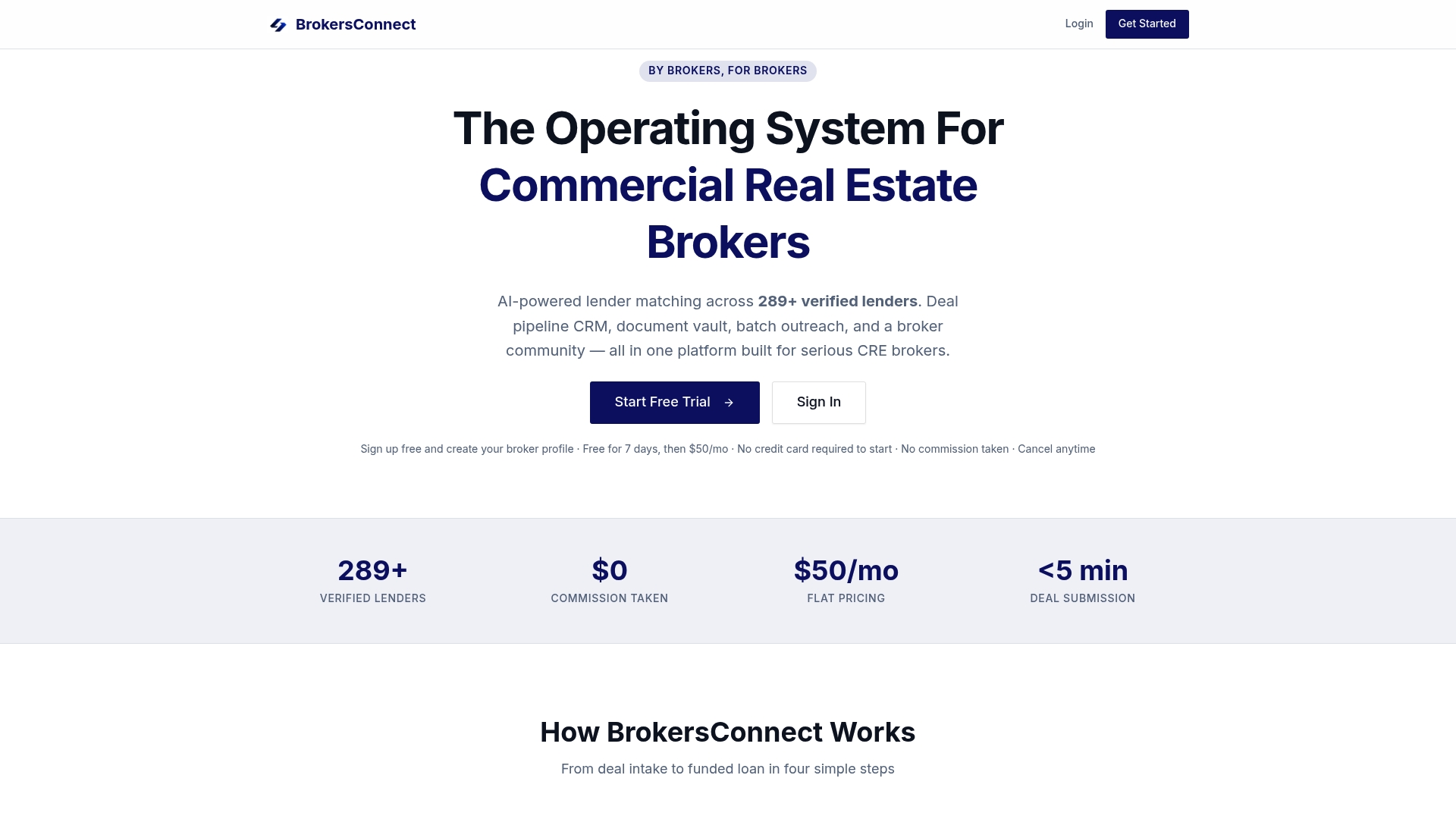
Once your licensing picture is clear for a state, you can start matching deals there. Start with BrokersConnect and see which lenders fit your next scenario. For how to read lender fit, see our matching guide to commercial mortgage lenders.
FAQ
Do commercial mortgage brokers need a license?
In some states, yes, and in others no. A few states have a dedicated commercial mortgage broker license, such as Arizona, some require a real estate broker license, and others exempt commercial-only activity. Check the state where the property sits, and for commercial financing products also the state of the borrower's business.
Do commercial loan brokers need a license?
There is no federal license for it. State law decides, and it can turn on the loan's size and purpose, as in California, or on the product, as with Texas's sales-based financing registration. Confirm with the state regulator before taking compensation.
Does a residential MLO license cover commercial loans?
Not automatically. A residential license sits under the SAFE Act framework, while commercial rules are set state by state. Some states exclude commercial loans from their residential licensing acts, as Illinois and Vermont do, so the two are treated separately.
How long does it take to get licensed?
It varies by state. In Arizona the regulator has 120 days from a completed application to grant or deny a mortgage broker or commercial mortgage broker license. Start before you need the license, not when the deal arrives.
Where can I check a state's requirements?
Start with the Mortgage Bankers Association's state licensing resource for commercial and multifamily lending, then the state regulator's website and statute. For anything unclear, ask a licensing attorney.
Sources
- Mayer Brown, Legal 500 Comparative Guide: Lending and Secured Finance, United States
- Vestevich & Associates, Commercial Lending Licensing
- Arizona Revised Statutes § 6-903
- Arizona Revised Statutes § 6-904 (2025)
- MBA, California commercial lending licensing
- DFPI California Financing Law license checklist (December 2023)
- Mayer Brown, California Moving to License All Commercial Loan Brokers?
- Illinois 205 ILCS 635/1-3
- Vermont Department of Financial Regulation, Financial Services
- MBA, Oregon commercial lending licensing
- Texas OCCC, Commercial Sales-Based Financing Rules: Final Adoption
- MBA, State Licensing Resource