
Check your state regulator and the NMLS to see whether commercial activity needs a license, since roughly half of states exempt it entirely while others require a full application. If you plan to touch any residential loans, budget for SAFE's 20-hour course and national exam. While that paperwork moves, start building lender relationships and pick one narrow specialty rather than chasing every deal type at once.
TL;DR:
- Most applicants should prioritize building lender relationships early, as they take months to mature and are key to closing deals quickly.
- Licensing requirements vary widely by state, with some exempting commercial brokers entirely, while others impose specific licensing or bond thresholds.
- Education requirements are different for commercial loans, often relying on documented experience rather than SAFE Act coursework, especially if the entire book is commercial.
- Initial setup costs typically range from $1,000 to $5,000, including entity formation, licensing fees, bonds, and basic operational tools, before earning commissions.
- Narrowing specialization to one or two asset types and creating repeatable submission templates significantly improves your chances of closing deals faster.
Table of Contents
- How to Become a Commercial Mortgage Broker: The Full Checklist
- Do Commercial Mortgage Brokers Need a License in Every State?
- SAFE Act vs. Commercial License: What Education Actually Applies
- What Does It Cost to Set Up a Compliant Brokerage?
- How Do You Land Your First Few Deals?
- How Long Does Licensing Actually Take?
- What Compliance Work Continues After You're Licensed?
- Your First Loan Submission: A 10-Step Checklist
- What Actually Separates Fast Starters From Everyone Else?
- How BrokersConnect Speeds Up Your First Deals
- Sources
How to Become a Commercial Mortgage Broker: The Full Checklist
Getting licensed and funded isn't one process, it's three running at once: figuring out your legal obligations, assembling paperwork, and building the relationships that actually generate income. Here's the order that avoids wasted motion.
- Decide your lane. If you'll ever originate a residential loan, you need SAFE Act coverage and an MLO license. Purely commercial brokers in many states skip this entirely, but confirm it with your specific state regulator before assuming you're exempt.
- Pull your documentation together. Most applications want personal financial statements, a summary of your professional history, and fingerprints for a background check. Corporate officers typically need to disclose ownership stakes and any past disciplinary actions.
- Handle education or experience credentials. States that require commercial licensing sometimes accept documented industry experience instead of formal coursework. Where a course is mandatory, enroll early since exam scheduling can add weeks to your timeline.
- File through NMLS or your state's portal. Most participating states route commercial and mortgage-related applications through the NMLS system, which also hosts licensing checklists and the MU1/MU2 forms you'll need to compile state-specific requirements.
- Budget for your bond and startup costs while you wait. Application review isn't instant, so use this window to secure your surety bond quote, set up your business entity, and start lender outreach. Nothing in your license application prevents you from networking now.
The biggest mistake applicants make is treating licensing as a single gate to clear before doing anything else. Lender relationships take months to mature, so the brokers who launch fastest run licensing and business development in parallel from day one.
Do Commercial Mortgage Brokers Need a License in Every State?
No, and this is where most first-time applicants get confused. Commercial-broker licensing requirements vary dramatically by state, and there's no single federal standard governing purely commercial transactions the way SAFE governs residential lending. Some states require a dedicated commercial license or layer a real estate broker license on top of mortgage activity, while a substantial number exempt commercial-only brokers from licensing altogether.
That patchwork means you cannot assume your state's rules mirror a neighboring state's, even in commercial lending corridors that look similar on paper. Here's how to verify your actual obligations before you spend a dollar on applications:
- Search your state's financial regulator or banking department website for "mortgage broker license" and "commercial lending" specifically, not just "mortgage license."
- Check whether your state routes applications through NMLS or requires a separate state-specific portal submission.
- Confirm bond and net worth thresholds directly on the regulator's page, since third-party guides sometimes lag behind fee updates.
- Note the stated review timeline, since some states process applications in two to three weeks while others routinely run 60 to 90 days.
Arizona is a useful real-world example. The state's Department of Insurance and Financial Institutions publishes new application fees and a renewal fee schedule, and those fees are nonrefundable regardless of when you submit. That single detail, a nonrefundable fee tied to submission timing, is exactly the kind of line item that trips up applicants who don't read the fine print before filing.
SAFE Act vs. Commercial License: What Education Actually Applies
The SAFE Act only governs residential mortgage loan originators, so its 20 hour pre-licensure course and national exam apply when you're touching residential deals, not purely commercial ones. If your entire book of business will be commercial real estate, many states let you skip SAFE entirely and rely on a different set of credentials, often built around documented experience rather than a fixed classroom hour count.
Where states do impose commercial-specific education, the requirements look different from state to state:
- Some states accept a set number of years working in commercial lending, underwriting, or real estate finance in lieu of coursework.
- Others require a qualifying individual, meaning at least one licensed officer at your brokerage must meet a minimum experience threshold before the business itself can operate.
- State-level guides for markets like Texas and California show meaningfully different pre-licensure hour requirements and exam scheduling windows, so what satisfies one state's regulator may fall short in another.
If you lack formal coursework, document your experience carefully. Pull old employment letters, deal summaries, and any transaction records showing your role in structuring or closing commercial loans. Career overviews for the role commonly cite a bachelor's degree or equivalent finance and real estate experience as the baseline expectation, which gives you a benchmark for what a regulator or hiring broker will want to see on paper.
What Does It Cost to Set Up a Compliant Brokerage?
Forming a legal entity, usually an LLC, separates your personal assets from business liability and is close to mandatory before any lender or regulator takes you seriously. Beyond the entity itself, you'll need a business bank account, an EIN, and in most states a registered agent for service of process.
The surety bond is the line item that catches new brokers off guard. Bond face values (the amount a claimant could recover) commonly range from $10,000 to $100,000 depending on the state, while your actual premium, the amount you pay annually, usually runs a small percentage of that face value based on your credit profile.
By the Numbers: Origination income on a closed deal typically runs 1% to 3% of the funded loan amount, which means your first-year costs need to be weighed against realistic deal flow, not just the license application fee.
Other costs to plan for before your first commission check arrives:
- NMLS registration and processing fees, which vary by state and license type.
- State filing fees for your application, often nonrefundable once submitted.
- Fingerprinting and background check fees, typically $40 to $60 per set.
- A basic CRM or deal-tracking tool, since spreadsheets stop working once you're juggling more than a handful of active files.
How Do You Land Your First Few Deals?
Specialization is the single fastest way to shorten your learning curve as a new broker. Practitioner guidance consistently favors narrowing to one or two asset classes or loan types, like small-balance multifamily, DSCR rental loans, or bridge financing, rather than trying to be a generalist from day one. Lenders trust brokers who clearly understand one box well over brokers who claim to do everything.
- Pick a niche you can actually underwrite in your head. Small-balance multifamily and DSCR loans are common starting points because the underlying metrics (debt service coverage, cap rate, rent roll quality) are learnable in weeks, not years.
- Build a short list of three to six lenders active in that niche. Study their published guidelines, minimum loan sizes, and geographic focus before you ever pick up the phone.
- Learn each lender's real appetite, not just their marketing page. Call and ask directly what deal profile they're actively funding this quarter, since published criteria often lag behind what's actually getting approved.
- Use a verified lender-matching platform to compress research time. A tool like BrokersConnect cuts the cold-calling grind by surfacing lenders whose stated criteria already fit your deal.
- Show up where lenders already gather. Industry events, local CRE associations, and referral relationships with commercial real estate agents fill your pipeline faster than cold outreach alone.
Pro Tip: Build one clean, repeatable submission template before you ever pitch your first deal. A tight, consistent package tells a lender you're organized before they've reviewed a single number, and that first impression shapes how much attention your future submissions get.
The SBA's Lender Match program is worth exploring even if your deals fall outside SBA parameters, since it's a free way to see how lenders categorize themselves by loan type and borrower profile.
How Long Does Licensing Actually Take?
Most straightforward applications clear in two to twelve weeks, but that range hides real variation. States with high application volume or a manual review process routinely run 60 to 90 days, especially if your file includes any credit or background flags that trigger additional review.
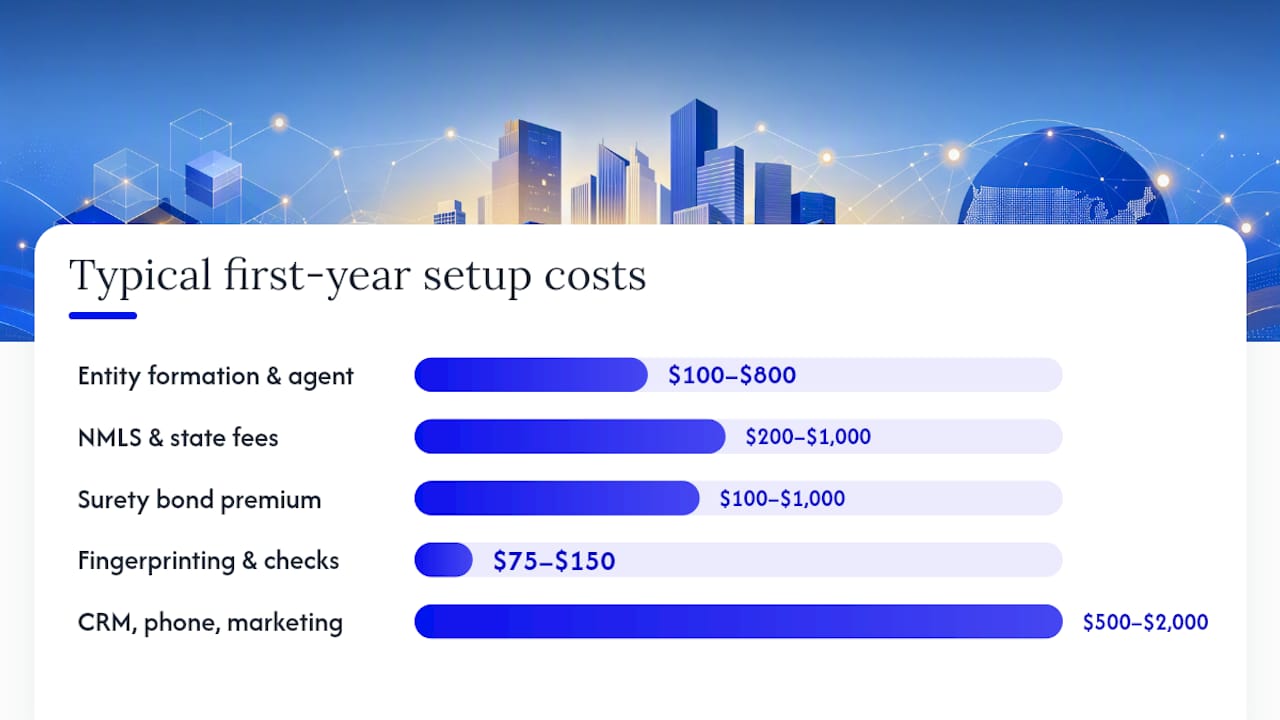
Sample first-year budget for a solo commercial broker:
- Business entity formation and registered agent: $100 to $800
- NMLS and state filing fees: $200 to $1,000, depending on jurisdiction
- Surety bond premium: $100 to $1,000 annually, based on bond face value and credit
- Fingerprinting, background check, and credit report: $75 to $150
- Basic CRM, phone, and marketing tools: $500 to $2,000
By the Numbers: A conservative first-year setup budget lands somewhere between $1,000 and $5,000 before you count your own living expenses while deal flow ramps up.
Multi-state filings, incomplete paperwork, and any past credit issues are the three biggest sources of delay. Submit clean the first time.
What Compliance Work Continues After You're Licensed?
Getting licensed is the entry fee, not the finish line. Most states require periodic renewal, and where continuing education applies, it's usually a modest annual hour requirement rather than a repeat of your original coursework.
- Track your renewal date the moment you're licensed, since lapses can force you to reapply from scratch in some states.
- Run basic AML and OFAC screening on new clients and counterparties before you submit a deal, since lenders increasingly expect brokers to have already checked this before a file lands on their desk.
- Keep organized records of every submission, communication, and disclosure, since documentation gaps are what turn a routine audit into a real legal problem.
- Loop in legal counsel the moment a deal involves unusual entity structures, foreign ownership, or any regulatory gray area you haven't handled before.
Your First Loan Submission: A 10-Step Checklist
Placing your first deal comes down to preparation, not luck. Lenders reward brokers who submit clean files the first time and waste as little of their underwriting attention as possible.
- Confirm the borrower's entity structure and get a signed application or letter of intent.
- Collect two to three years of borrower financial statements and tax returns.
- Pull the property's rent roll, operating statement, and any existing loan documents.
- Order or request a recent appraisal, or confirm one is already in progress.
- Verify the borrower's credit profile and any existing debt schedule.
- Match the deal against your shortlist of active lenders whose appetite fits the property type and loan size.
- Write a lender-specific cover memo highlighting the deal strengths that matter to that particular lender.
- Propose realistic terms based on comparable closed deals, not aspirational pricing.
- Submit the complete document package in one clean batch rather than trickling files in over days.
- Follow up within 48 hours, then track lender questions closely to keep closing readiness on schedule.
What Actually Separates Fast Starters From Everyone Else?
Most new brokers fail not because they can't get licensed, but because they never build a lender network deep enough to place a deal quickly. The fix is almost embarrassingly simple: pick three to six lenders, actually learn their appetite, and stop submitting deals that don't fit.

Specialization sounds like a limitation until you watch what it does to your close rate. A broker who deeply understands DSCR underwriting closes faster than a generalist juggling five asset classes, because lenders trust precision over breadth. Submission cleanliness matters more than most new brokers assume. A tight package with the right documents in the right order tells a lender you respect their time, and that reputation compounds across every deal after your first.
Build one habit early: template everything. The brokers who scale fastest aren't smarter, they're just not reinventing their submission process every single time.
— Theron
How BrokersConnect Speeds Up Your First Deals
Thecrebrokersconnect exists for exactly the gap this whole process exposes: licensing gets you legal to operate, but nothing about a state application teaches you which lenders actually want your deal. Thecrebrokersconnect is the alternative to weeks of cold-calling lender lists, built around a database of 289+ verified lenders you can filter by property type, loan amount, credit profile, and structure.
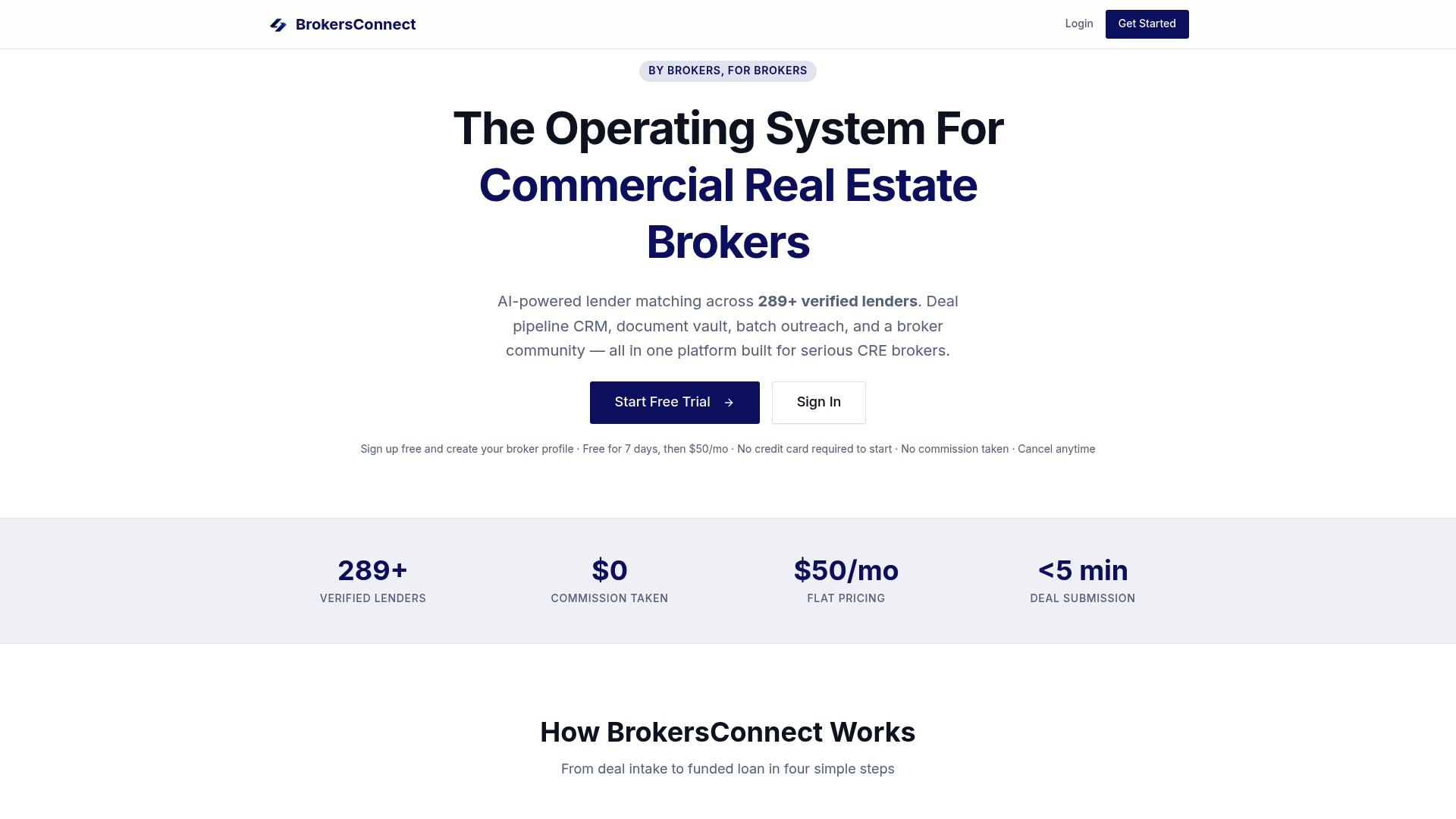
Instead of guessing which lender fits your DSCR or bridge deal, the platform matches your scenario against real lender criteria and surfaces the ones actually likely to say yes. Submission templates keep your first packages clean and consistent, the pipeline CRM tracks every conversation so nothing falls through during your busiest weeks, and the lender responsiveness leaderboard tells you who actually replies before you waste days waiting. For a new broker still building relationships, that combination replaces months of trial and error with a working shortcut.
Start a free trial at Thecrebrokersconnect and see which lenders fit your first deal before you make a single cold call.
Sources
- Licensing | Mortgage Lending | DIFI
- Nmls
- Commercial Mortgage Broker License Requirements by State - LegalClarity