
For most commercial real estate financings, lenders require four core third-party reports: an MAI appraisal (market value), a Property Condition Assessment or PCR (physical condition), a Phase I Environmental Site Assessment (contamination risk), and a zoning report (compliance and entitlements). These aren't checkbox formalities. They're the objective verification layer that tells lenders whether the deal is priced right, physically sound, environmentally clean, and legally usable — the transaction's truth-check.
Your first move: confirm the lender's approved-vendor list before placing a single order, then attach the appraisal and PCA to the initial loan submission package.
Quick-start checklist before ordering:
- Property address, APN/tax ID, and legal description
- Lender name and contact for vendor approval confirmation
- Target delivery dates for each report (work backward from your closing date)
- Loan type and asset class (these affect scope requirements)
- Access instructions and property contact for site inspections
Key Takeaways
Third-party reports for CRE financing are underwriting inputs, not paperwork — managing them proactively determines how fast a deal closes and on what terms.
| Point | Details |
|---|---|
| Four core reports | MAI appraisal, PCA/PCR, Phase I ESA, and zoning report are required for most CRE financings. |
| Confirm vendors first | Verify lender-approved vendor lists before ordering to avoid report rejection and costly re-orders. |
| PCA as capital planning | Use the PCR's cost tables to build a Reserve and CapEx summary slide for lender presentations. |
| Bundle and order simultaneously | Placing all reports at once, not sequentially, is the most reliable way to compress the overall timeline. |
| Thecrebrokersconnect | The platform centralizes lender matching, document storage, and submission templates to reduce report management friction. |
Table of Contents
- What do the core third-party CRE reports actually cover?
- Who orders the reports, who pays, and why independence matters
- How lenders use third-party reports when underwriting a loan
- How to procure reports efficiently: bundling, vendors, and platforms
- What timelines and costs should you expect?
- What standards and credentials should you verify?
- A ready-to-use ordering checklist for any third-party report
- Why third-party reports are a competitive advantage, not just a compliance hurdle
- Thecrebrokersconnect gives you a faster path from report order to loan approval
- Sources
What do the core third-party CRE reports actually cover?
Each report answers a specific underwriting question. Lenders don't use them interchangeably, and neither should you when packaging a submission.
MAI appraisal
The appraisal answers one question: what is this property worth? Specifically, it establishes market value using the income, sales comparison, and cost approaches, with the income approach typically weighted most heavily for income-producing assets. Only appraisers holding the MAI designation from the Appraisal Institute are widely accepted by institutional lenders and agencies for commercial assignments, as detailed in local commercial market guidance and listings. Deliverables include a narrative report with comparable sales analysis, income and expense projections, a highest-and-best-use conclusion, and a certified value opinion. Lenders use the appraised value to set the loan-to-value ratio, which directly determines maximum loan proceeds.
Property Condition Assessment (PCA) and Property Condition Report (PCR)
The PCA is the physical inspection; the PCR is the written report that results from it. ASTM E2018-24 sets the industry standard for scope and reporting, covering structural systems, MEP (mechanical, electrical, plumbing), roofing, life-safety, and ADA compliance. Qualified engineers, architects, or specialized consulting firms perform PCAs. The PCR delivers findings, photographs, and cost tables showing immediate repair needs and projected capital expenditures over a 10–12 year horizon. Lenders pull the immediate repair cost and the annual reserve requirement directly from those tables to set escrow amounts and adjust net operating income.
Pro Tip: Treat the PCR not as a defect list but as a capital planning roadmap. A well-organized cost table gives lenders the reserve schedule they need and gives sponsors a long-range capex budget — two audiences, one document.
Phase I Environmental Site Assessment (ESA)
The Phase I ESA identifies recognized environmental conditions (RECs) — past or present contamination risks — through records review, site reconnaissance, and interviews, without any soil or groundwater sampling. ASTM E1527-21 governs the standard practice. Environmental professionals (EPs) with appropriate credentials perform the assessment. The deliverable is a written report with a REC summary and a conclusions section. A clean Phase I with no RECs clears the environmental box for most lenders. Any identified REC typically triggers a Phase II (sampling), which can alter loan terms, require environmental indemnities, or in severe cases kill the deal.
Zoning report
The zoning report confirms that the property's current use is legally permitted, identifies any nonconforming status, and summarizes entitlements, setbacks, and permitted uses under the applicable municipal code. Zoning attorneys or specialized research firms prepare these. Deliverables include a written opinion or certificate covering current zoning classification, conforming/nonconforming status, and any variances or special permits. Lenders use it to confirm that the collateral can be rebuilt to its current use if destroyed, and that no regulatory change threatens the income stream.
Report comparison at a glance
| Report | Primary purpose | Who performs it | Typical timeline | Key deliverables | Lender use in underwriting |
|---|---|---|---|---|---|
| MAI Appraisal | Establish market value | MAI-designated appraiser | 3–5 weeks | Narrative report, comps, value conclusion | Sets LTV, max loan proceeds |
| PCA / PCR | Assess physical condition | Licensed engineer or architect (ASTM E2018) | 2–3 weeks | Findings, photos, immediate repair and reserve cost tables | Reserve escrow, capex adjustments to NOI |
| Phase I ESA | Identify environmental risk | Environmental professional (ASTM E1527) | 2–3 weeks | REC summary, conclusions, recommendations | Environmental indemnity, Phase II trigger |
| Zoning Report | Confirm legal use and compliance | Zoning attorney or research firm | 1–2 weeks | Zoning certificate, conforming status, entitlements | Confirms collateral usability and rebuild rights |
Who orders the reports, who pays, and why independence matters
The short answer: lenders usually control the ordering process, even when borrowers foot the bill.
Most institutional lenders and agencies require that reports be ordered directly through them or through their approved-vendor list. The reason is independence. A report commissioned by the borrower or seller carries an inherent conflict of interest, and lenders know it. When the lender orders the report, the vendor's client relationship is with the lender, not the party trying to close the deal. That relationship is what makes the findings credible in underwriting.
Typical roles and billing practices:
- The borrower almost always pays for third-party reports, either as a direct fee or as part of loan closing costs
- The lender or its counsel signs the scope of work and selects the vendor from an approved list
- Approved-vendor lists vary by lender; a vendor accepted by one bank may not be on another's list
- Seller-provided reports are generally not accepted unless the lender reviews and re-addresses them, or commissions an independent report review
When a seller hands you a Phase I or PCA from their own consultant, don't assume the lender will accept it. The fastest path is to call the lender's closing coordinator before the deal goes under contract and ask two questions: Is this vendor on your approved list? Will you accept a report review rather than a full new assessment?
That single conversation can save two to three weeks and several thousand dollars in duplicate report fees.
How lenders use third-party reports when underwriting a loan
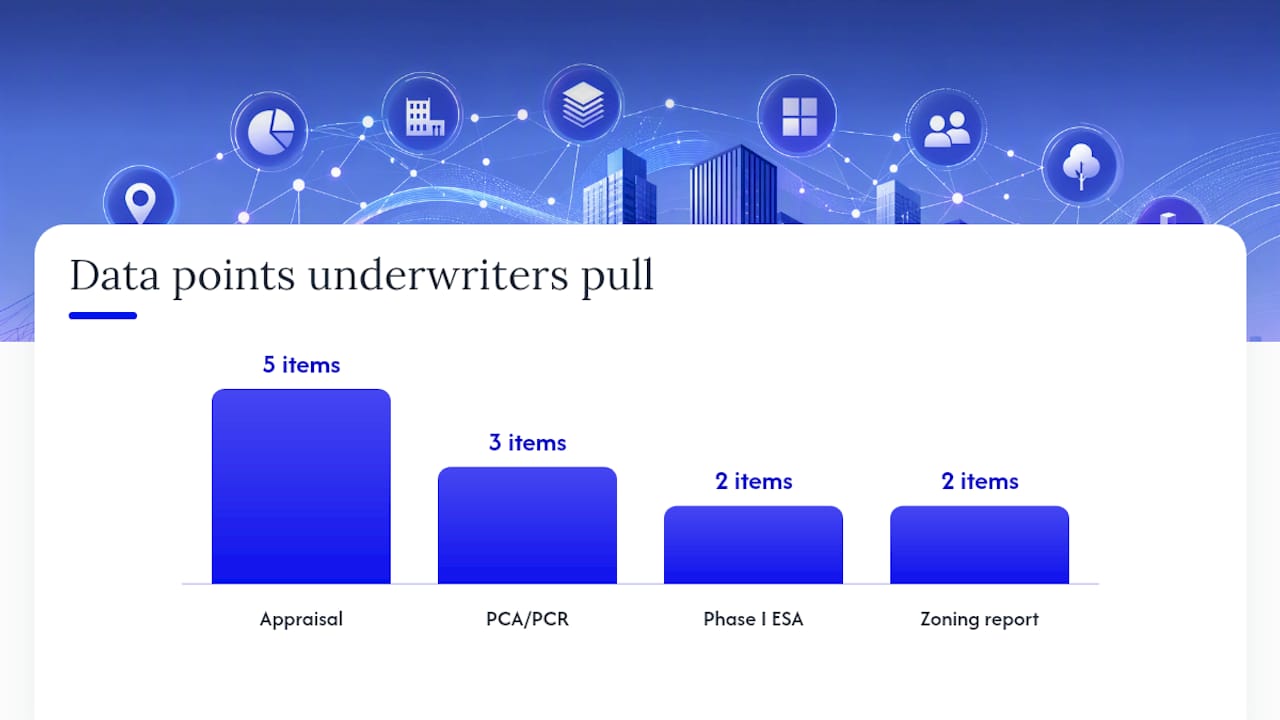
Underwriters don't read these reports cover to cover. They extract specific data points that feed the credit model. Knowing what they're looking for helps you surface those answers in your submission rather than making them hunt.
What underwriters pull from each report:
- Appraisal: Market value, cap rate, comparable sales, income and expense assumptions, and highest-and-best-use conclusion. These inputs set the LTV ceiling and validate the sponsor's rent roll projections.
- PCA/PCR: Immediate repair costs (often escrowed at closing), annual replacement reserve per unit or per square foot, and any deferred maintenance that affects stabilized NOI. A large immediate repair number can reduce net proceeds or require a repair escrow holdback.
- Phase I ESA: REC status and any recommended Phase II testing. A REC triggers additional due diligence, environmental indemnity requirements, or lender-specific environmental insurance. A clean Phase I is a green light.
- Zoning report: Conforming or nonconforming status and rebuild rights. A nonconforming property that cannot be rebuilt to its current use after a casualty is a material risk that affects insurance requirements and sometimes loan structure.
Sample lender submission callouts (include these in your cover memo):
- Appraised value: $X,XXX,000 (MAI appraisal, [Firm Name], dated [Date])
- Immediate repairs: $XX,000 (PCA, [Firm Name]); proposed repair escrow: $XX,000
- Phase I status: No RECs identified (Phase I ESA, [Firm Name], dated [Date])
- Zoning: Conforming use; rebuild rights confirmed
Negative findings don't automatically kill a deal, but they do change the structure. A large deferred maintenance number typically becomes a repair escrow. A REC becomes an environmental indemnity or a Phase II requirement. A nonconforming zoning status may require a higher insurance limit or a legal nonconforming endorsement. Flagging these proactively in your submission memo, with your proposed mitigation, moves the deal faster than waiting for the underwriter to raise them.
How to procure reports efficiently: bundling, vendors, and platforms
Ordering four reports from four separate vendors, on four separate timelines, is the single biggest source of closing delays in CRE transactions. There are three practical procurement paths.
Lender-ordered: The lender places the order directly with its approved vendor. You provide property access and information. This is the cleanest path for lender acceptance but gives you the least control over timing and vendor selection.
Borrower-ordered through approved vendors: You or the borrower order directly from a vendor on the lender's approved list. You control the timeline and can push for faster delivery. Acceptance risk is low as long as the vendor is confirmed in advance.
Third-party marketplaces and platforms: Services like Due5 centralize quote requests, vendor directories, order placement, and delivery tracking across multiple report types. Bundling orders through a single platform reduces coordination friction and can shorten overall timelines when multiple reports are needed simultaneously.
Procurement method comparison
| Method | Speed | Vendor control | Acceptance risk | Fee drivers |
|---|---|---|---|---|
| Lender-ordered | Moderate (lender pace) | None | Very low | Lender fee schedule |
| Borrower-ordered (approved vendor) | Faster (you control) | High | Low if pre-confirmed | Market rate, property complexity |
| Marketplace / platform bundle | Fastest coordination | Moderate | Low with pre-vetted vendors | Platform fee plus vendor fees |
Vendor checklist before placing any order:
- Confirmed on lender's approved-vendor list
- Carries adequate E&O and general liability insurance (confirm lender's required limits)
- MAI designation (appraisals) or ASTM E2018/E1527 compliance (PCA/Phase I)
- Stated turnaround time in writing
- Experience with the specific asset class (industrial, multifamily, retail, etc.)
Recommended broker workflow:
- Collect property identifiers and confirm lender's approved-vendor list (Day 1)
- Pre-vet two to three vendors per report type against that list
- Place bundled orders simultaneously, not sequentially
- Confirm site access with the property contact before inspection dates
- Track delivery against your closing timeline; follow up at the midpoint
- Upload completed reports to your loan file and include summary callouts in the submission cover memo
What timelines and costs should you expect?
Timelines vary by asset class, property complexity, and vendor workload. These are working ranges, not guarantees.
Typical delivery timelines:
- MAI appraisal: 3–5 weeks for standard assets; 6–8 weeks for complex or specialty properties (hotels, self-storage, healthcare)
- Phase I ESA: 2–3 weeks for standard sites; longer if historical records are incomplete or the site has prior industrial use
- PCA: 2–3 weeks; larger portfolios or properties with deferred maintenance requiring specialist review can run 4+ weeks
- Zoning report: 1–2 weeks for most markets; longer in jurisdictions with slow municipal response times
Primary cost drivers:
- Property size and complexity (a 500-unit multifamily costs more to assess than a 20-unit)
- Asset class (specialty assets require specialist consultants)
- Site access delays (vacant properties, tenant coordination, gated sites)
- Phase II testing triggered by a Phase I REC (adds cost and 3–6 additional weeks)
- Rush fees when timelines are compressed
Common bottlenecks and how to get ahead of them:
- Access delays: Confirm site access in writing before the inspection date, not the day before
- Vendor capacity: Order early; peak transaction seasons create backlogs at top-tier firms
- Lender vendor approval: Confirm the vendor list before ordering, not after the report is delivered
- Scope gaps: Provide complete property information (square footage, year built, recent capital improvements) at order placement to avoid scope revisions mid-engagement
- Sequential ordering: Place all reports simultaneously; waiting for the Phase I before ordering the PCA adds weeks with no benefit
What standards and credentials should you verify?
A report is only as good as the lender's willingness to accept it. These are the signals that determine acceptance.
Standards and trust signals lenders rely on:
- ASTM E2018-24: The governing standard for PCAs. Any PCA submitted to an institutional lender should reference this standard explicitly in the scope and certification sections.
- ASTM E1527-21: The governing standard for Phase I ESAs. Reports that don't cite this standard or that were prepared under an older version may be rejected.
- MAI designation: The Appraisal Institute's MAI credential is the baseline requirement for commercial appraisals at most institutional lenders and all agency lenders.
- Fannie Mae Multifamily Guide: Fannie Mae's guidance specifies required reports, timing relative to forward commitments and conversions, and acceptable vendor credentials for multifamily loans. If you're placing a multifamily deal with an agency lender, this is the document to read before ordering anything.
Red flags that get reports rejected:
- Missing or unsigned certification page
- No photographs or inadequate photo documentation for a PCA
- Scope that doesn't match the asset type (a retail PCA scope applied to an industrial property)
- Vendor not on the lender's approved list (discovered after delivery)
- Inadequate E&O insurance limits relative to the loan amount
- Phase I prepared under ASTM E1527-05 rather than the current E1527-21 standard
- Appraisal signed by a state-certified residential appraiser rather than a commercial MAI
When a report review is the right call:
When a seller provides a report from a non-approved vendor, commissioning a full new assessment isn't always necessary. An independent report review evaluates the existing assessment against ASTM criteria and is commonly accepted by lenders as a lower-cost alternative, provided the lender agrees in advance. This path works best when the underlying report is recent (within 12 months), the vendor is credible, and the lender's primary concern is a quality check rather than a full re-inspection.
Pro Tip: Before ordering a full new Phase I on a seller-provided report, call the lender and ask whether they'll accept a report review. If the answer is yes, you've just saved the borrower $1,500–$3,000 and two weeks.
A ready-to-use ordering checklist for any third-party report
Copy this into your order email or platform submission to make sure vendors deliver what lenders expect.
Property identifiers:
- Full property address and county
- Assessor's Parcel Number (APN) / tax ID
- Legal description or site map
- Property type and current use
- Gross square footage, year built, number of units (if applicable)
Lender and transaction information:
- Lender name and closing contact
- Loan type (bridge, permanent, construction, agency)
- Target closing date and required report delivery date
- Lender's approved-vendor confirmation (attach email or reference)
Scope of work references:
- For PCA: ASTM E2018-24 standard scope
- For Phase I ESA: ASTM E1527-21 standard practice
- For appraisal: MAI-designated appraiser, USPAP-compliant narrative report
- For zoning: current zoning classification, conforming/nonconforming status, rebuild rights, permitted uses
Access and logistics:
- Property contact name and phone number
- Access instructions (key box, tenant coordination, security requirements)
- Any known access restrictions or tenant sensitivities
Deliverables and format:
- PDF report with signed certification
- Photographs embedded in report (not separate files)
- Cost tables in editable format (PCA)
- Delivery to: [broker email] and [lender closing contact email]
One small adjustment that consistently speeds acceptance: include the lender's name and loan number in the report's certification section at order placement, not as a revision request after delivery. Most vendors will address the report to the lender if you provide that information upfront.
Why third-party reports are a competitive advantage, not just a compliance hurdle
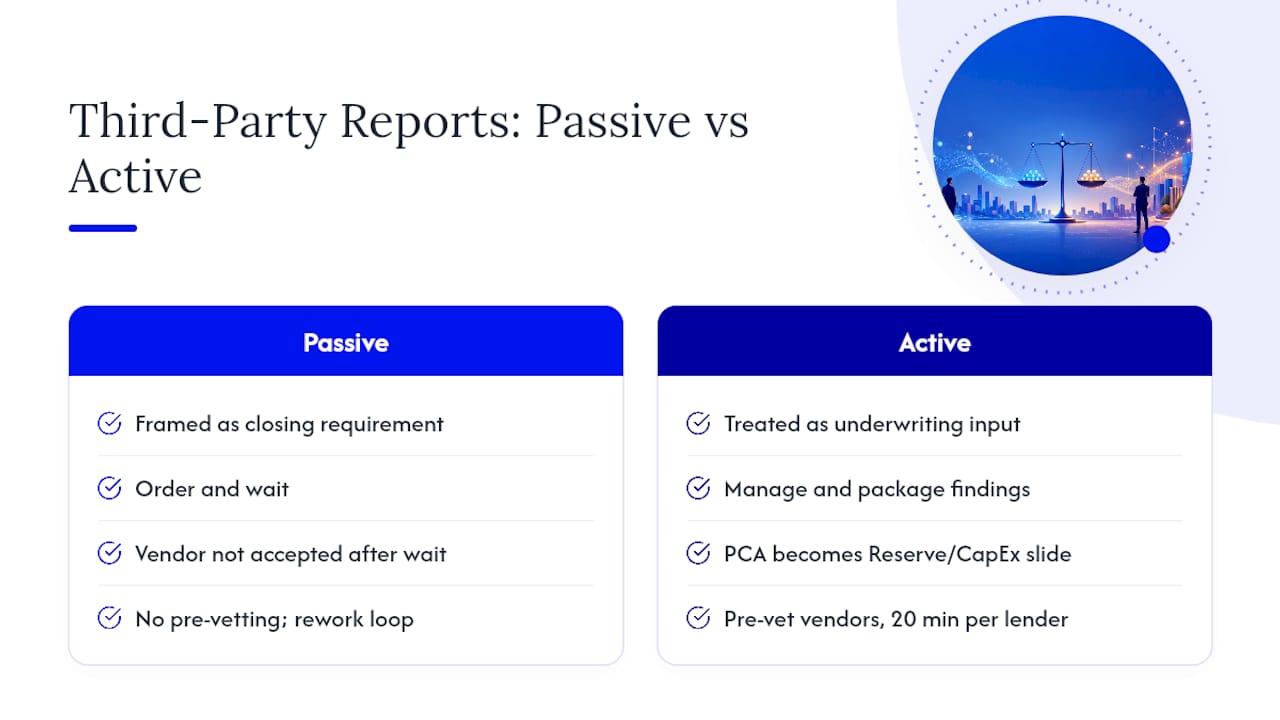
Most brokers treat third-party reports as a closing requirement — something to order and wait for. That framing costs deals.
The brokers who close faster and with fewer lender conditions are the ones who treat reports as underwriting inputs they actively manage. The PCA's cost table becomes a Reserve and CapEx summary slide in the lender presentation. The Phase I's REC section gets a one-paragraph response in the submission memo explaining why the risk is manageable or already remediated. The appraisal's income assumptions get cross-referenced against the rent roll before the lender ever sees the file.
Pre-vetting vendors against lender approved lists before a deal is even under contract is the single highest-leverage habit in this process. It takes 20 minutes per lender relationship, and it eliminates the most common rework loop in CRE financing: ordering a report, waiting three weeks, and then learning the vendor isn't accepted. That loop doesn't just cost money. It costs credibility with the lender and, sometimes, the deal itself.
The other underused move: when a seller provides a Phase I or PCA, don't dismiss it automatically. Check the vendor, check the date, and ask the lender whether a report review against ASTM criteria is acceptable. That conversation has saved borrowers thousands of dollars and weeks of timeline on transactions where the underlying report was solid.
Third-party reports are the most objective data in any CRE transaction. Brokers who know how to read them, package them, and present their findings proactively don't just move faster — they look like the most prepared person in the room.
Thecrebrokersconnect gives you a faster path from report order to loan approval
Coordinating four vendors, tracking four delivery timelines, and uploading reports to four different lender portals is where deals slow down. Thecrebrokersconnect centralizes that workflow so you spend less time chasing vendors and more time closing.
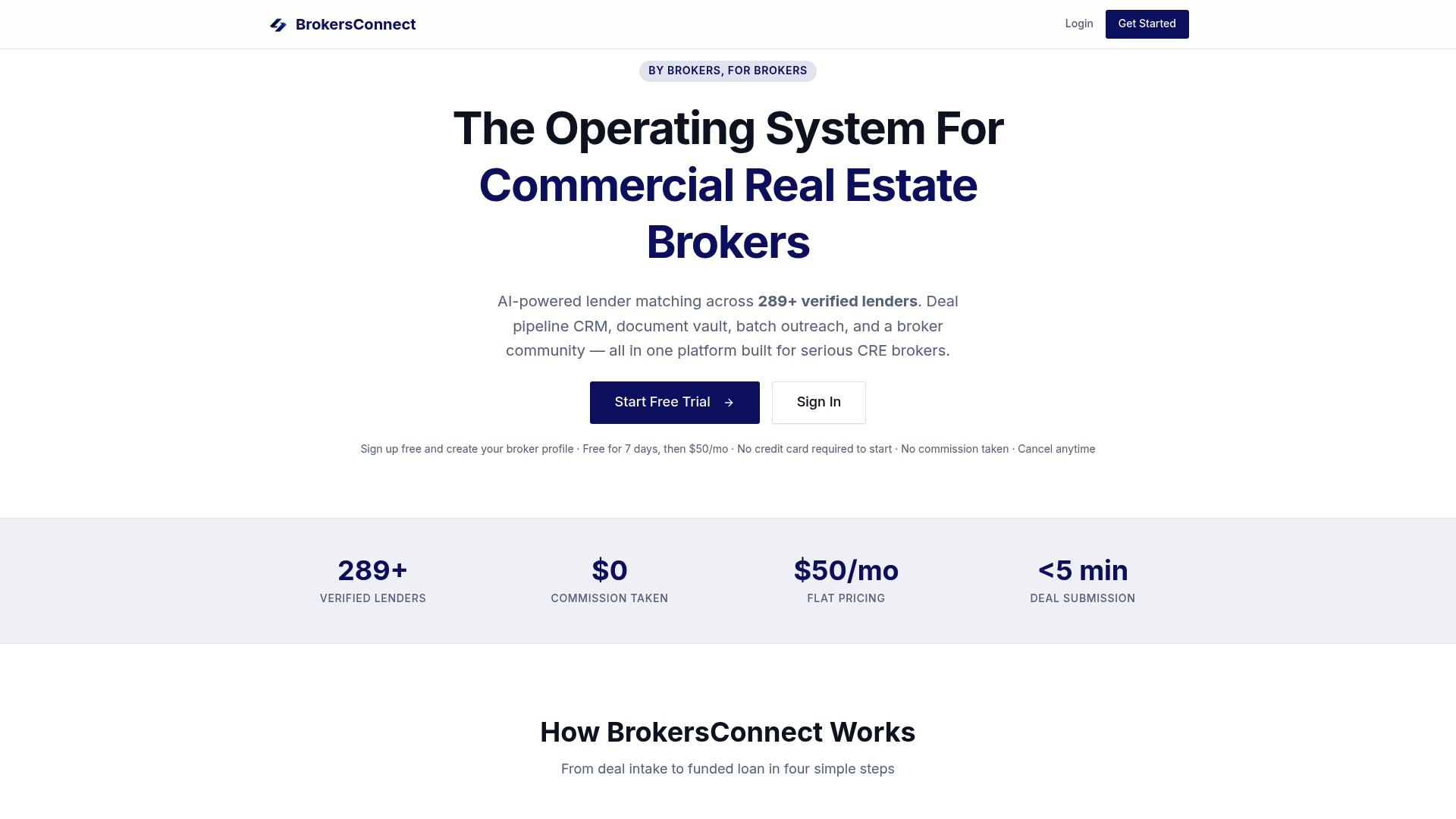
The platform gives CRE brokers access to a database of 289+ verified lenders, with lender-specific requirements surfaced at the deal-matching stage so you know which reports each lender expects before you order. The secure document vault keeps your PCA, Phase I, appraisal, and zoning report organized and shareable with lenders in one place. Deal templates and AI document tools help you pull key callouts from reports and format them for submission memos without starting from scratch.
No commission. No transaction fees. A flat monthly subscription with a free trial period. Start your free trial at Thecrebrokersconnect and run your next deal through a platform built for the way brokers actually work.
Sources
These are the primary references for CRE third-party report standards, lender requirements, and procurement options.
- 3rd-Party Reports in CRE Financing
- ASTM E2018-24
- Order Third-Party CRE Reports Fast and Easy Process | DUE5
- Independent Due Dilgence Report Review - CREtelligent
- Third-Party Reports | Fannie Mae Multifamily Guide