
For a stabilized acquisition, a conventional bank loan or CMBS is usually your fastest path to closing. For ground-up construction or a first-time purchase with limited capital, SBA 7(a) or SBA 504 financing opens doors that conventional lenders won't. Here is the short version by deal purpose, so you can stop researching and start preparing:
- Stabilized acquisition: Conventional bank or credit-union CRE loan or CMBS for deals above $2M. Lenders want 85%+ occupancy and 90 days of operating history. Expect 35% down at a bank.
- Ground-up construction: SBA 7(a) or a construction-to-perm bank loan. SBA 7(a) loans can go up to $5 million and allow as little as 10–15% down for owner-operators, though closings run 60–90 days.
- Refinance/cash-out: Life-insurance company loan for large, stabilized assets; CMBS for non-recourse flexibility; bank for smaller deals with existing relationships.
- Value-add/lease-up: Bridge loan or debt-fund capital. Speed matters more than rate here. Expect floating rates and 12–24 month terms.
- Working capital or equipment: SBA 7(a) covers both. It is one of the few products that bundles real estate and operating capital in one note.
Your immediate first step: pull your trailing 12-month NOI, current rent roll, and a personal financial statement. Those three documents determine which products you qualify for before you ever call a lender.
Pro Tip: Contact a specialist SBA lender or use a broker platform like Thecrebrokersconnect before approaching a conventional bank. SBA-approved lenders underwrite storage differently than generalist commercial lenders, and the difference in leverage can be 15–20 percentage points.
Key Takeaways
The most important rule in self storage financing is this: lenders size your loan from NOI-driven DSCR first, so run that math before you approach any lender or your loan amount will surprise you at underwriting.
| Point | Details |
|---|---|
| Match loan to deal purpose | SBA for high-leverage or construction; CMBS/life-company for stabilized, non-recourse; bank for sub-$5M relationships. |
| DSCR is the binding constraint | Most lenders require 1.20–1.25x DSCR on in-place NOI before LTV even enters the conversation. |
| SBA and CMBS close slowly | Budget 60–90 days for SBA and CMBS; bridge and hard-money close in 1–6 weeks when speed is critical. |
| Prepare three documents first | Trailing 12-month NOI, current rent roll, and a personal financial statement open every lender conversation. |
| Thecrebrokersconnect for brokers | Brokers sourcing storage financing can use Thecrebrokersconnect to match deals to verified lenders and manage submissions in one platform. |
Table of Contents
- What are the main self storage financing options?
- How do self storage loan types compare?
- How do lenders underwrite a self-storage deal?
- What does self storage financing actually cost?
- How do you choose the right loan and negotiate better terms?
- Where do you find active self-storage lenders?
- What the current lending market actually rewards
- Thecrebrokersconnect gives brokers a faster path to storage capital
What are the main self storage financing options?
Self storage financing draws from six distinct loan categories, and the right one depends almost entirely on your deal profile, not your preference.
SBA 7(a) loans
The SBA 7(a) program is the most flexible government-backed option for storage operators. It covers acquisition, construction, renovation, and working capital under a single note, with loan amounts typically up to several million dollars. Owner-operators can qualify with relatively low down payments, which is a meaningful advantage over the higher down payments most conventional banks require. The tradeoff is time: SBA closings generally take a couple of months, and the program charges an upfront guarantee fee that adds to closing costs. For a first-time buyer or an operator expanding into a new market, that leverage advantage usually outweighs the slower pace.
SBA 504 loans
The SBA 504 program splits the loan between a conventional bank (typically 50% of the project) and a Certified Development Company (CDC), which funds 40% at a long-term fixed rate. The borrower covers the remaining 10%. That structure makes 504 particularly useful for large acquisitions or major facility improvements where locking a fixed rate on the CDC piece provides predictable debt service for 20–25 years. The CDC debenture carries a longer prepayment schedule than 7(a), so factor that in if you plan to sell or refinance within five years.
Conventional bank and credit-union loans
Banks and credit unions handle the majority of smaller storage deals in the U.S. Typical terms involve moderate loan-to-value ratios with longer amortization and fixed-rate periods before repricing or balloon payments. Personal recourse is standard. The upside is relationship pricing: a borrower with an existing banking relationship can often negotiate better rates and faster processing than a cold application. The downside is that banks underwrite the operator as much as the asset, so thin operating history or a weak personal financial statement will cost you on rate or leverage.
CMBS loans
CMBS financing suits stabilized, cash-flowing storage assets with loan amounts typically starting around $2 million. These are fixed-rate, non-recourse loans with 5- or 10-year terms and 30-year amortization, which makes them attractive for operators who want to remove personal liability. The catch: CMBS loans are securitized and serviced by a trust, so modifications after closing are nearly impossible. Defeasance or yield-maintenance prepayment penalties are steep. Use CMBS when you plan to hold long-term and the asset is fully stabilized.
Life-insurance company loans
Life companies are the most selective lenders in the storage market, but they offer the best long-term fixed rates for the right deal. They target larger, institutional-quality assets in primary and secondary markets, typically $5M and above, with conservative LTVs around 55–65%. Non-recourse terms are common. If your facility is stabilized, well-located, and you can wait 60–90 days for underwriting, a life-company loan can lock in the lowest fixed rate available in the market.
Bridge and construction loans
Bridge lenders and debt funds step in when a deal doesn't fit permanent financing yet. A lease-up play, a conversion from another use, or a newly constructed facility waiting for stabilization all need short-term capital with flexibility. Terms typically run 12–36 months at floating rates, with interest-only payments during the hold period. Speed is the primary value: some debt funds can close in 2–4 weeks. For construction specifically, local banks offering construction-to-perm loans are often the most practical path, since they can roll the construction note into permanent financing once the facility reaches stabilization. For faster bridge capital, private money lenders fill the gap when conventional timing won't work.

Hard-money and private lenders
Hard-money lenders prioritize speed and collateral over borrower credit. Rates are higher, terms are short, and fees are significant, but when a deal requires a 10-day close or the borrower's credit profile doesn't fit conventional boxes, private capital gets it done. Use hard-money as a bridge to better financing, not a permanent solution.
Seller financing
Seller financing is underused in storage acquisitions. When a seller carries a note, the buyer avoids bank underwriting entirely, which can accelerate closing and allow creative structures. It works best when the seller owns the asset free and clear and wants installment-sale tax treatment. Always have an attorney structure the note carefully.
How do self storage loan types compare?
| Loan Type | Best For | Typical Loan Size | Max LTV | Term & Amortization | Rate Type | Recourse | Time to Close |
|---|---|---|---|---|---|---|---|
| SBA 7(a) | Acquisition, construction, working capital | Up to $5M | Up to 85–90% | 10–25 yr / 25 yr | Fixed or variable | Full recourse | 60–90 days |
| SBA 504 | Large acquisitions, major improvements | $2M+ | Up to 90% (10% down) | 20–25 yr fixed (CDC piece) | Fixed (CDC) | Full recourse | 60–90 days |
| Bank/Credit Union | Sub-$5M stabilized deals | $5 million | 65% | 5–10 yr fixed / 20–25 yr amort | Fixed or floating | Full recourse | 30–60 days |
| CMBS | Stabilized assets, non-recourse need | $2M+ | 55–65% | 5 or 10 yr / 30 yr amort | Fixed | Non-recourse | 60–90 days |
| Life-Insurance | Large, institutional-quality assets | $5M+ | 55–65% | 10–30 yr / 25–30 yr amort | Fixed | Non-recourse | 60–90 days |
| Bridge/Debt Fund | Lease-up, conversion, reposition | $1M–$50M+ | 70–80% | 12–36 months / IO | Floating | Recourse or partial | 2–6 weeks |
| Hard-Money/Private | Speed-critical, credit-challenged | $5 million | 60–70% | 6–24 months / IO | Fixed (high) | Full recourse | 1–2 weeks |
| Seller Financing | Off-market, creative structures | Negotiable | Negotiable | Negotiable | Fixed or variable | Negotiable | Days to weeks |
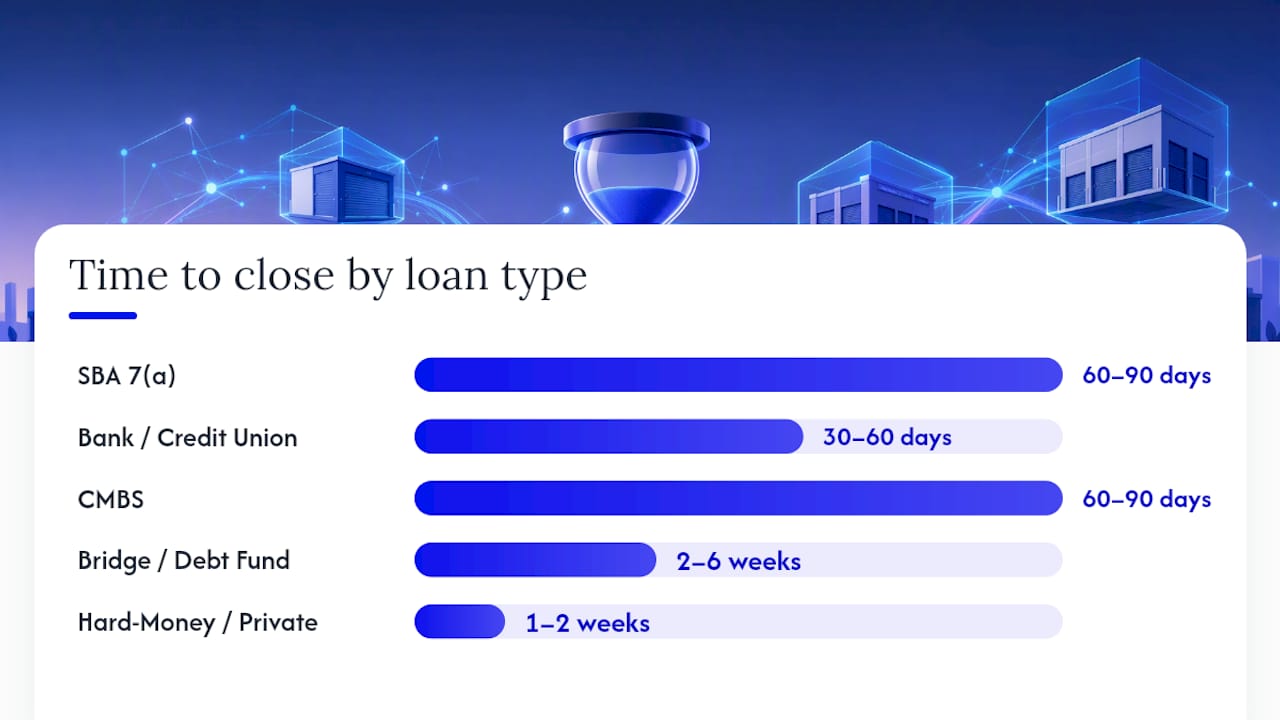
Two trade-offs dominate every loan-type decision. The first is leverage versus speed: SBA products offer the highest leverage but the slowest closings; bridge and hard-money lenders close fast but at a fraction of the leverage and a multiple of the cost. The second is non-recourse versus flexibility. CMBS and life-company loans remove personal liability, but they lock you into rigid servicing terms. A bank loan keeps you on the hook personally but gives you a lender you can actually call when something changes.
How do lenders underwrite a self-storage deal?
Underwriting for storage financing starts with one number: net operating income. Everything else, including LTV, flows from it.
The primary metrics lenders use
Debt service coverage ratio (DSCR) is the first gate. Most conventional lenders require a minimum DSCR of 1.20–1.25x on in-place NOI, meaning the property generates at least $1.20 in net income for every $1.00 of annual debt service. DSCR-focused lenders size the loan from NOI first, then check whether the resulting loan amount falls within their LTV ceiling. If your NOI supports a lower loan than your LTV would allow, the NOI wins. That surprises a lot of first-time storage borrowers who assume LTV is the binding constraint.
Debt yield, calculated as NOI divided by the loan amount, is a secondary check used heavily by CMBS lenders. A typical CMBS debt yield floor runs 8–10%. Occupancy matters too: most permanent lenders want 85%+ physical occupancy for at least 90 days before they'll underwrite to in-place income rather than pro forma.
Borrower-level requirements
Lenders evaluate the operator as closely as the asset, particularly for sub-$5M deals at community banks. Expect scrutiny of:
- Personal credit score (typically 680+ for conventional; 650+ for SBA)
- Personal financial statement showing liquidity and net worth
- Two to three years of personal and business tax returns
- Operator experience: prior storage management or CRE ownership history
- Post-closing reserves: most lenders want 3–6 months of debt service in reserve
Lender-ready document checklist
- Trailing 12-month profit and loss statement (T-12)
- Current rent roll with unit mix, rates, and occupancy by unit type
- Last two to three years of tax returns (personal and entity)
- Personal financial statement
- Purchase contract or letter of intent (for acquisitions)
- Site survey, appraisal, and Phase I environmental report
- Business plan or stabilization narrative (for value-add or construction deals)
- Construction budget and timeline (for ground-up or conversion projects)
Pro Tip: Lenders size the loan from NOI-driven DSCR before they look at LTV. Run your own DSCR math before you submit: take your trailing NOI, divide by your target annual debt service, and confirm you're above 1.25x. If you're not, either the loan amount needs to come down or the NOI story needs to improve before you approach a lender.
What does self storage financing actually cost?
Rate ranges vary by product, and the gap between the cheapest and most expensive capital in this market is wide.
Conventional bank loans for stabilized storage currently price in a range tied to the prime rate or Treasury benchmarks, with spreads that reflect borrower strength and LTV. SBA 7(a) rates are variable and tied to the prime rate with a lender spread, making them sensitive to Federal Reserve moves. The Inside Self-Storage analysis on rate-environment shifts notes that lower-rate windows create real opportunity to lock long-term fixed debt, but borrowers should resist the temptation to max leverage just because rates have softened. A loan you can service at 80% occupancy is worth more than a slightly larger loan that breaks even only at 95%.
Life-company and CMBS loans typically offer the lowest fixed rates in the market for qualifying assets, though CMBS adds structuring costs, rating agency fees, and legal expenses that can push total closing costs to 1.5–2.5% of the loan amount. SBA loans carry an upfront guarantee fee (which varies by loan size and term) plus standard third-party costs: appraisal, environmental, title, and legal. Bridge and hard-money lenders charge origination fees of 1–3 points plus higher rates, making them expensive on an annualized basis but sometimes the only viable option for a time-sensitive deal.
A practical example: on a $3M acquisition with a bank loan at 70% LTV, you're putting in $900,000 of equity. Add appraisal ($5,000–$10,000), environmental ($2,000–$5,000), title and legal ($15,000–$25,000), and origination (0.5–1%), and your total out-of-pocket at closing runs $950,000–$1,000,000 before reserves. Budget 3–5% of the loan amount for total closing costs as a conservative floor.
Time-to-close by product:
- Hard-money/private: 1–2 weeks
- Bridge/debt fund: 2–6 weeks
- Bank/credit union: 30–60 days
- CMBS: 60–90 days
- SBA 7(a) or 504: 60–90 days, sometimes longer for construction
- Life-insurance company: 60–90 days
SBA closings are slower because of documentation requirements and the SBA review layer. Construction draws add another variable: most construction lenders fund in stages tied to inspection milestones, so cash flow planning during the build phase is critical.
How do you choose the right loan and negotiate better terms?
Start with deal purpose, then work backward to product fit.
- Check your occupancy and NOI — Below 85% occupancy or less than 90 days of operating history eliminates most permanent lenders. That's a bridge or SBA situation.
On negotiation: most borrowers focus on headline rate and miss the terms that actually matter at exit. Push for interest-only periods on value-add deals, which preserve cash flow during lease-up. Ask for recourse burn-off provisions tied to occupancy milestones. For SBA deals, understand the prepayment schedule before signing: 7(a) instruments often carry a declining prepayment penalty in the early years, and 504 CDC debentures have a longer tail. If you're comparing term sheets, look at the effective yield over your expected hold period, not just the note rate.
When to use a broker: if you're approaching more than two lender types or your deal has any complexity (lease-up, construction, mixed-use, out-of-state), a broker's lender relationships will save you weeks and often improve terms. A good broker has closed similar deals recently and can tell you which lenders are actively quoting storage in your market right now.
Where do you find active self-storage lenders?
Sourcing the right lender is half the work. Most borrowers approach one or two banks and accept whatever terms they get. Active lenders in the storage space are not evenly distributed, and the ones most likely to approve your deal depend on loan size, geography, and deal type.
Step-by-step lender sourcing:
- Identify your loan type based on the decision framework above.
- For SBA deals, find an SBA Preferred Lender Program (PLP) lender with storage experience. Not all SBA lenders understand storage underwriting.
- For conventional deals under $5M, start with local and regional banks that have existing CRE portfolios in your market.
- For CMBS or life-company loans, you almost always need a broker. These lenders rarely take direct borrower applications.
- For bridge or private capital, finding active private lenders requires knowing who is currently deploying capital, since appetite shifts quickly with market conditions.
- Run parallel outreach: submit to at least three lenders simultaneously and compare term sheets before committing to one.
Broker screening checklist:
- Closed storage deals in the last 12 months (ask for examples)
- Active relationships with lenders in your loan-size range
- Clear fee model (typically 0.5–1% of loan amount, paid at closing)
- Uses a structured submission process, not a one-page email
- Can explain why a specific lender fits your deal, not just "we know everyone"
The difference between a generalist broker and a storage-specialist broker shows up in lender access. CMBS conduits and life companies allocate storage capacity selectively, and a broker who placed a deal with them last quarter has a warmer path than a cold call.
What the current lending market actually rewards
The conventional advice on self storage financing is to find the lowest rate. That's the wrong frame. What lenders are actually rewarding right now is borrower preparedness and deal clarity.
Lender appetite for storage has remained relatively strong compared to other CRE asset classes, partly because storage has demonstrated resilient occupancy through economic cycles. But selectivity has increased. Lenders who were approving pro forma underwriting on lease-up deals a few years ago are now demanding more seasoning and tighter DSCR cushions. The rate environment matters, but the bigger shift is in documentation standards and lender risk tolerance.
The borrowers who get the best terms are not the ones with the lowest rates on their term sheets. They're the ones who walk in with a clean T-12, a credible stabilization narrative, and a broker who has placed a similar deal with that lender before. Relationship capital is real capital in this market. A lender who knows your broker's track record will move faster and price better than one reading a cold submission.
The other thing most guides understate: the difference between SBA lenders is enormous. Two PLP lenders can look at the same storage deal and come back with materially different leverage, rate, and timeline. Shopping SBA lenders is not optional; it's part of the process.
Thecrebrokersconnect gives brokers a faster path to storage capital
Sourcing the right lender for a storage deal takes time most brokers don't have. Cold-calling lenders, chasing term sheets, and managing document requests across multiple conversations is where deals stall.
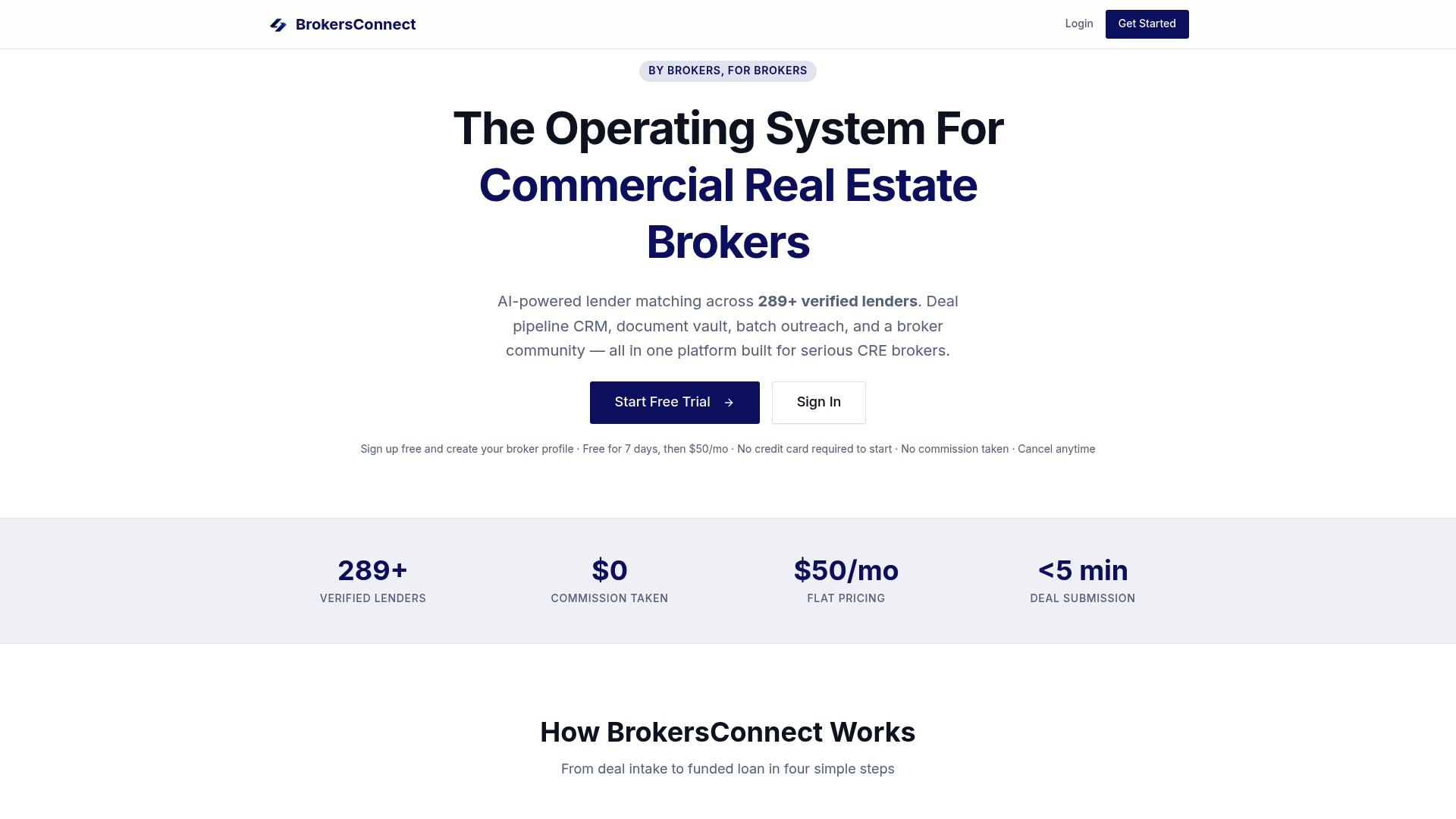
Thecrebrokersconnect is built for commercial mortgage brokers who need to move faster. The platform's lender-matching engine filters 289+ verified lenders by property type, loan size, geography, leverage, and loan purpose, so a broker working a self-storage acquisition can identify the most likely lenders in minutes rather than days. Batch outreach, a secure document vault for submission packages, and a lender responsiveness leaderboard mean brokers spend less time chasing and more time closing. If you're a broker working storage deals, start a free trial at Thecrebrokersconnect and see how much of your sourcing process can be cut.
Thecrebrokersconnect is a platform for commercial real estate brokers and is not itself a lender. It does not originate, underwrite, or fund loans.
Useful sources
- SBA 504 loans — sba.gov
- Financing opportunities for self-storage borrowers in a lower interest rate environment — Inside Self-Storage
- Self-Storage Financing Guide — My Real Estate Calculator
- SBA Self-Storage Loans — sba504blog.com
- Self Storage Facility Loans: The Complete Financing Guide for Storage Owners — Crestmont Capital
- Best Self Storage Loans: Financing Options, Requirements, and How to Qualify in 2026 — Nav