
Global cash flow is the combined repayment capacity of a borrower and every related entity or guarantor tied to a loan, and lenders measure it with one formula: Total global cash available ÷ Total global debt service = Global DSCR. Anything below 1.00 means the borrower group cannot cover its combined debt from its own cash; most commercial policies want more cushion than that.
Building the number correctly means pulling together several pieces, not just one tax return:
- Adjusted business cash flow (EBITDA plus normalized add-backs) from every operating entity tied to the guarantor
- Verified cash distributions from K-1s, not allocated taxable income
- Personal income the guarantor actually receives: wages, rental income, investment income
- Total debt service across every entity and the guarantor personally, including the proposed loan
Skip the eliminations step and the whole exercise falls apart. Intercompany rent, management fees, and loans between related entities get counted twice unless someone strips them out, and unverified distributions can make a thin borrower look comfortably solvent on paper. Global cash flow analysis only works when someone actually checks that the cash moved.
Key Takeaways
Global cash flow works because it forces verification of every dollar claimed across a borrower's full entity structure, not just the one applying for the loan.
| Point | Details |
|---|---|
| Formula and eliminations | Global DSCR equals total global income divided by total global debt service, and intercompany transfers must be eliminated first. |
| Three documents that prove cash is real | Bank statements, K-1 distribution records, and signed leases confirm income actually moved, not just what was reported. |
| Fatal calculation errors | Counting allocated K-1 income as cash and double-counting shared debt across entities are the two most common mistakes. |
| Where automation pays off | K-1 tracing and intercompany elimination logic benefit most from tools like FINPACK's GCFA module. |
| Policy thresholds to know | Ratios below 1.00x need mitigants immediately; 1.25x and above is comfortable for most commercial policies. |
Table of Contents
- Why Lenders Run a Global Cash Flow Analysis
- What Documents You Need Before You Build the Model
- How to Calculate Global Cash Flow: Step by Step
- Common Adjustments and Pitfalls in Global Cash Flow Analysis
- Applying Global Cash Flow to Underwriting Decisions
- Tools and Templates That Speed Up Global Cash Flow Work
- A Verification Checklist and the Red Flags That Signal Trouble
- How Global Cash Flow Differs from Traditional Cash Flow Analysis
- What a Global Cash Flow File Looks Like in Practice
- Where Global Cash Flow Analysis Falls Short
- Where Global Cash Flow Actually Changes the Decision
- Frequently Asked Questions
- Sources
Why Lenders Run a Global Cash Flow Analysis
Single-entity DSCR tells you whether one borrowing entity's income covers its own debt. It says nothing about whether the guarantor behind that entity is also propping up two other businesses, personally carrying a jumbo mortgage, or drawing distributions the operating company can't actually sustain. Global cash flow closes that gap.
The use cases where lenders insist on it are fairly predictable:
- Owner-guaranteed loans where an individual's personal guarantee is material to the credit decision, not a formality
- Owner-occupied commercial real estate, where the operating business and the real estate holding entity are financially intertwined
- Multi-entity sponsors who run several LLCs, S-corps, or partnerships that share cash, staff, or facilities
- SBA and bank loans where the guarantor holds 20% or more ownership, a threshold that regularly triggers a global requirement in SBA-adjacent underwriting practice
Closely held businesses tend to commingle personal and business finances more than lenders assume, and a single-entity view can be genuinely misleading about what the owner can actually support. Global analysis acts as a stress test on the whole guarantor structure, not just the entity signing the note.
There's also a compliance dimension. Examiners increasingly expect to see a documented global cash flow file on any deal where personal guarantees carry real weight, and missing or inconsistent global analyses show up regularly in exam findings. A credit file with no global workpaper on a heavily guaranteed loan is an easy target in a review.
What Documents You Need Before You Build the Model
You can't run a credible global cash flow analysis from a loan application and a gut feeling. Get the paper trail assembled before you touch a spreadsheet.
Core documents to collect:
- Business tax returns (three years, all entities tied to the guarantor)
- K-1s for every pass-through entity the guarantor owns a piece of
- Personal 1040s for the guarantor (and co-guarantors)
- A current Personal Financial Statement (PFS)
- Debt schedules covering both business and personal obligations
- Bank statements to confirm distributions actually landed in an account
- Lease agreements and management-fee schedules for any intercompany rent or service arrangements
Each document earns its place because it verifies something specific:
- K-1s versus bank statements. Check whether the distribution line on the K-1 matches money that actually hit the guarantor's account. Allocated taxable income and cash distributed are two different numbers, and treating them as the same thing is one of the most common mistakes in global analysis.
- Leases versus Schedule E. If a related entity pays rent to the guarantor's real estate LLC, that rent should reconcile against the Schedule E income reported and against the debt service on that property.
- Debt schedules versus tax return Schedule L. Confirm that every note payable shows up somewhere, so you're not missing an obligation the borrower forgot to disclose.
Foreign-owned entities need an extra layer of scrutiny. If part of the guarantor's cash flow comes from an offshore entity, you want Form 5472 filings, a documented dividend history, and clear evidence of legal transfer into the U.S. obligor's accounts. Cash that can't prove a legal, historical path to the borrower's pocket generally gets excluded or haircut rather than counted at face value.
How to Calculate Global Cash Flow: Step by Step
Here's the workflow that turns a folder of tax returns into a defensible Global DSCR.
- Map ownership and guarantors. Draw out every entity, its ownership percentage, and who guarantees what. This chart becomes your roadmap for the rest of the analysis.
- Gather documents for every entity and guarantor identified in step one, using the checklist above.
- Spread each entity's cash flow. Start with net income, add back depreciation, amortization, interest, and one-time items, and normalize officer compensation to a market rate if it's inflated or deflated for tax purposes.
- Calculate personal cash flow. Add wages, verified K-1 distributions, rental income, and other recurring personal income sources.
- List all debt service. Include every existing loan payment across every entity, the guarantor's personal obligations (mortgage, auto, personal loans), and the proposed new loan's principal and interest.
- Eliminate intercompany items. Strip out rent, management fees, or loans paid between entities owned by the same guarantor group, since counting both sides double-counts the same dollar.
- Compute Global DSCR: divide total global income by total global debt service.
Here's how that looks with real numbers, based on a worked example from Aloan's underwriting glossary:
| Line Item | Amount |
|---|---|
| Operating company cash distributed to guarantor | a substantial verified amount |
| Real estate LLC cash distributed to guarantor | a smaller verified amount |
| Guarantor consolidated cash available | combined verified cash available |
| Consolidated debt service (all entities + personal) | total consolidated debt service |
| Global DSCR | combined debt coverage ratio above typical policy minimums |
Once you've got a baseline Global DSCR, run it through a couple of stress scenarios. Add the proposed loan's full P&I to debt service and see where the ratio lands. Then remove one distribution stream entirely, as if that entity had a bad year, and check whether the guarantor group still covers its debt. If the ratio collapses below 1.00 under a single removed income source, that's a concentration risk worth flagging in the credit memo, not burying in a spreadsheet tab.
Pro Tip: Build your spreadsheet so every income line links back to a labeled source document (K-1 page number, bank statement date). When a reviewer or examiner asks where a number came from six months later, you want to answer in ten seconds, not reopen the whole file.
Common Adjustments and Pitfalls in Global Cash Flow Analysis
The math in a Global DSCR calculation is simple division. The mistakes happen upstream, in how the inputs get built. Wipfli's review of practitioner files found recurring issues that show up across lenders of every size: missing entity consolidations, inconsistent methods from one analyst to the next, and thin documentation behind the adjustments.
The pitfalls worth watching for, specifically:
- Counting allocated K-1 income as cash. Allocated taxable income is a tax concept tied to ownership percentage; it says nothing about whether the entity actually distributed cash. Confirm distributions against bank deposits before counting a dollar of it.
- Double-counting entity debt. If two entities co-guarantee the same loan, that obligation belongs in total debt service once, not twice.
- Ignoring intercompany rent or management fees. If Entity A pays Entity B $5,000 a month in rent and both entities roll into the same guarantor's global cash flow, that $5,000 needs to come out of one side of the ledger or it inflates combined income artificially.
- Treating one-time gains as recurring income. A property sale gain or a PPP loan forgiveness event boosted last year's numbers, but it won't repeat, so it shouldn't anchor a repayment projection.
For each of these, the fix is the same discipline: normalize officer compensation to a defensible market rate rather than whatever the tax preparer used, flag non-recurring items explicitly rather than folding them into a three-year average, and keep a written rationale for every adjustment. That documentation is what lets an adjustment survive an internal credit review or a regulatory exam months after the file closed, per the red-flag guidance Abrigo outlines for common examiner pushback.
Applying Global Cash Flow to Underwriting Decisions
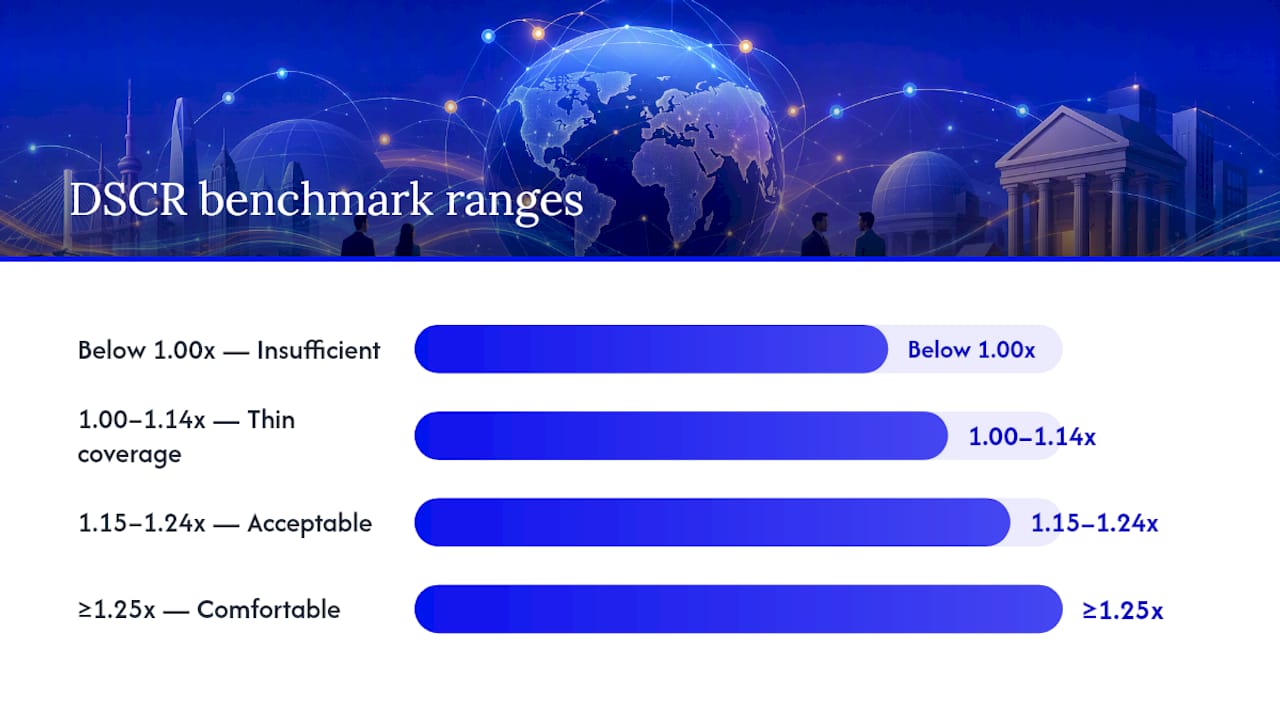
A Global DSCR number by itself doesn't approve or decline a loan. It tells you how much cushion the borrower group has, and that cushion should shape pricing, structure, and what mitigants you require.
Policy benchmarks vary by institution, but a rough consensus has formed across commercial lenders:
- Below 1.00x: insufficient on its own; expect a decline or a requirement for substantial additional collateral or guarantees
- 1.00x to 1.14x: thin coverage, often requiring mitigants such as a personal guarantee enhancement, reserve requirement, or reduced leverage
- 1.15x to 1.24x: acceptable at many lenders, sometimes with a covenant requiring minimum DSCR maintenance
- 1.25x and above: comfortable for most commercial credit policies, per the benchmark ranges LenderAnalyzer compiles from lender practice
Once you have the base-case ratio, run it through a scenario checklist before it goes into the credit memo:
- Add the full proposed loan payment to total debt service and recalculate.
- Model a rate increase of 100 to 200 basis points if the loan carries a variable rate.
- Remove the largest single income source (one entity's distributions or the guarantor's largest personal income stream) and recalculate.
- Check whether the resulting ratio still clears your institution's policy floor under at least one stressed scenario.
Document the base case and every stressed scenario in the credit memo, not just the headline number. If the global result is thin even before stress testing, that's the trigger to restructure: require additional collateral, add a personal guarantee where none existed, tighten the amortization schedule, or price in a covenant tied to minimum DSCR. Brokers packaging a deal for a DSCR-focused lender should expect this exact analysis to shape both the rate quoted and the leverage a lender is willing to extend, especially on owner-occupied commercial mortgages where the operating business and the real estate sit under the same guarantor umbrella.
Tools and Templates That Speed Up Global Cash Flow Work
Two workflows dominate: build it yourself in a spreadsheet, or use a purpose-built tool.

Manual spreadsheet spreading gives you full control and costs nothing beyond the analyst's time, but it's also where most errors creep in. Forecasting complex, multi-entity cash flow on a spreadsheet tends to break down as entity count grows, because every new tab is another place to fat-finger a formula or forget an elimination.
| Approach | Strengths | Common Failure Modes |
|---|---|---|
| Manual spreadsheet | Full control, no software cost, flexible for one-off files | Formula errors compound across entities; inconsistent methods between analysts; no built-in audit trail |
| Automated GCFA tool (e.g., FINPACK) | Standardized K-1 tracing, built-in intercompany elimination logic, historical trend view, faster scenario testing | Requires clean source data upfront; less flexible for highly unusual ownership structures |
FINPACK's Global Cash Flow Analysis module consolidates multiple entities and guarantors into one combined view, automatically flags duplicated income so you're not double-counting distributions, and lets you run scenario tests across historical years to see how the global DSCR has trended, not just where it sits today.
Where automation adds the most value isn't the arithmetic, it's the tracing. Chasing K-1 distributions across five entities and matching them to bank deposits is tedious, error-prone work by hand. Tools built for this specifically standardize that elimination logic so the same rules apply every time, regardless of which analyst runs the file. For brokers packaging complex multi-entity deals, AI-assisted document extraction can pull K-1 figures and bank statement data directly into a spread, cutting the manual re-keying that introduces most transcription errors in the first place.
A Verification Checklist and the Red Flags That Signal Trouble
Run this sequence before you sign off on a global cash flow file, in roughly this order:
- Trace every K-1 distribution claimed to an actual bank deposit, not just the K-1's reported figure
- Confirm lease and rent income against the paying entity's actual disbursement, not just the lease agreement's stated amount
- Reconcile any due-from or due-to balances between related entities, since large unexplained balances often hide informal loans that should count as debt
- Recalculate the same file using a second analyst's methodology to confirm consistency before it goes to committee
A defensible verification sequence generally starts with the ownership map, moves through entity and personal spreads with clearly labeled eliminations, then closes with bank-statement confirmation and a two- to three-year scenario view showing how the proposed debt changes the picture.
Watch for these red flags specifically, since they show up repeatedly in examiner findings on global cash flow files:
- Allocated K-1 income used in place of confirmed distributions
- Offshore cash counted with no documented legal path or transfer history to back it
- Large, unexplained due-from or due-to balances between related entities
- Officer compensation adjustments made with no written rationale
- Two different analysts calculating the same borrower's global DSCR two different ways
Pro Tip: If your shop handles more than a handful of multi-entity files a quarter, standardize the elimination template across every analyst. Inconsistent methodology between staff is one of the most common findings Wipfli flags in bank exam reviews, and it's entirely preventable with a shared template.
How Global Cash Flow Differs from Traditional Cash Flow Analysis
Traditional cash flow analysis looks at one borrowing entity in isolation: does this business's operating income cover this loan's payment? It's a clean, contained calculation that works fine when the borrower is a single-entity operator with no other meaningful obligations or income sources.
Global cash flow analysis asks a bigger question: does the entire guarantor group, across every entity and every personal income source, generate enough combined cash to cover every combined obligation? The mechanics differ in three concrete ways. First, global analysis requires an ownership map before you can even start, since you need to know every entity tied to the guarantor. Second, it requires intercompany eliminations that a single-entity spread never touches. Third, it pulls personal financial statements and 1040s into the picture, sources a traditional entity-level DSCR calculation never needs.
The practical effect: a business that looks marginal on a standalone basis might clear easily on a global basis if the guarantor has strong outside income, and a business that looks strong standalone might reveal thin coverage once you load in the guarantor's other debt obligations. Neither number alone tells the full story, which is exactly why lenders run both.
What a Global Cash Flow File Looks Like in Practice
On a standalone basis, the operating company's DSCR looks solid at 1.6x. But the real estate LLC carries its own mortgage, and the guarantor also has $12,000 a month in personal debt service across a jumbo mortgage and two auto loans.
Run it globally, using the mechanics from the worked example earlier in this guide: combine the guarantor's $150,000 in verified operating company distributions with $15,000 in real estate LLC distributions, eliminate the intercompany rent the operating company pays the LLC (since it shows up as expense on one side and income on the other), then add total debt service across both entities and the guarantor's personal obligations. The resulting global DSCR comfortably exceeds typical policy floors, indicating the guarantor's overall position is strong, not just the one entity applying for the loan.
Now flip the scenario: same guarantor, but the real estate LLC's distributions turn out to be allocated K-1 income with no matching bank deposits. Once you strip that unverified $15,000 out and add the guarantor's $12,000 monthly personal debt service that got missed in an earlier draft of the file, the ratio drops substantially, potentially close to or below a policy floor. That's the difference verification makes: the same borrower, the same entities, but a materially different credit decision depending on whether someone actually checked the bank statements.
Where Global Cash Flow Analysis Falls Short
Global cash flow is a snapshot built on trailing tax returns and current debt schedules, and it assumes the recent past predicts the near future. That assumption breaks down fast for businesses with volatile revenue, seasonal cash flow, or a recent ownership change that hasn't shown up in a full tax cycle yet.
The analysis also depends heavily on the completeness of what the borrower discloses. An analyst can only eliminate intercompany transfers and debt obligations that show up in the documents provided. An undisclosed entity, an informal loan from a family member, or a guarantee the borrower forgot to mention doesn't get caught by even the most rigorous spreadsheet.
Foreign income adds another layer of uncertainty. Even with documented transfer history and a legal path to the U.S. obligor, currency volatility, foreign tax withholding, and transfer friction mean offshore cash flow carries more real risk than domestic income of the same face value, which is exactly why haircuts on that income are standard practice rather than optional caution. And a strong global DSCR calculated today says nothing about how the guarantor's other entities might perform in a downturn that hits every business in the group simultaneously, a risk global analysis is built to expose but can't actually predict.
Where Global Cash Flow Actually Changes the Decision
The files where global cash flow analysis matters most aren't the clean ones. A single-entity operator with no other holdings barely needs it. It's the guarantor running three LLCs, leasing space between two of them, and drawing distributions that don't quite match what the K-1 says, where the whole credit decision hinges on whether someone traced the cash instead of trusting the tax return.
Underwriters who skip the bank-statement verification step aren't saving time, they're deferring risk to whoever reviews the file next, often an examiner with less patience for gaps than a colleague would have. The judgment calls, normalizing officer comp, deciding whether a gain was truly one-time, applying a haircut to offshore income, are where the real analysis happens. Write those decisions down. A credit memo that shows the base case, the stressed scenarios, and the reasoning behind each adjustment holds up in a review. One that just states a final DSCR number does not.
If you're working a file where the global picture doesn't match what the standalone numbers suggested, that gap is usually the most useful thing in the whole underwriting package. It's worth flagging explicitly rather than smoothing over.
Frequently Asked Questions
What's the difference between Global DSCR and a standard DSCR? Standard DSCR measures one entity's income against its own debt. Global DSCR combines every related entity's income and every related obligation, including the guarantor's personal debt, into one consolidated ratio.
Do allocated K-1 income and distributed K-1 income mean the same thing? No. Allocated income is a tax figure tied to ownership percentage, and it doesn't necessarily reflect cash that left the entity. Only count distributions confirmed against bank deposits.
What Global DSCR do most lenders require for approval? Requirements vary by institution and loan type, but many commercial policies treat 1.25x or higher as comfortable, while ratios between 1.00x and 1.14x usually require additional mitigants.
How does foreign-sourced income factor into a global cash flow calculation? Offshore income needs documented proof of a legal transfer path and a historical pattern of transfers into the U.S. obligor's accounts. Undocumented or inconsistent offshore cash is typically excluded or discounted.
Can a broker use global cash flow analysis to strengthen a loan package? Yes. Presenting a clean, verified global cash flow file with eliminations and scenario testing already done gives lenders less reason to slow the file down for additional documentation requests.
This article is general information, not a substitute for advice from a qualified financial advisor. Consult a qualified financial professional about your own circumstances before acting on anything here.
Sources
- Global cash flow analysis: Common mistakes & helpful hints
- Global Cash Flow Analysis: How Lenders Calculate It - LenderAnalyzer
- What is Global Cash Flow Analysis? | Aloan
- A look at the common issues seen with global cash flow | Wipfli
If your brokerage regularly packages deals with multi-entity guarantors, working with lenders through Thecrebrokersconnect gets your global cash flow file in front of institutions that already expect this level of consolidated analysis, matched by property type, leverage, and guarantor structure instead of a cold-call list. For deals involving leased commercial space where Schedule E income needs verification against actual lease terms, a partner like Milwaukee Property Management can help confirm the rent roll a borrower's real estate LLC is claiming.