
Credit pull authorization isn't optional in most cases: the Fair Credit Reporting Act (FCRA) allows a business to pull your credit only when it has a permissible purpose, and for anything you're applying for, written consent is the standard. Some pulls, like account reviews on cards you already hold, prescreened offers, or a court order, don't need your signature. The CFPB and FTC both publish guidance on exactly where that line falls.
TL;DR:
- Most credit pulls require written consent, especially for applications like loans, credit cards, or employment screening, with some exceptions like prescreened offers.
- Electronic signatures are legally valid, but it's crucial to request a copy of the authorization before disputes arise to ensure proof of consent.
- Hard inquiries from loan applications cause temporary score drops, while soft inquiries do not affect your score and are visible on your credit report.
- If your credit was pulled without permission, you should dispute the inquiry, review your credit reports, and consider fraud alerts or identity theft reports if necessary.
- Valid authorization forms should include the requester's name, purpose, scope, duration, signature, and language about adverse actions to protect all parties involved.
Table of Contents
- Who Can Legally Pull Your Credit Report Under the FCRA
- Written, Verbal, or Electronic Consent: What Actually Counts
- Hard Pulls vs. Soft Pulls: Why the Difference Matters for Your Score
- What to Do If Your Credit Was Pulled Without Authorization
- What a Legitimate Authorization Form Should Include
- Why Clean Authorization Records Protect Everyone in the Deal
- Where to Verify These Rules Yourself
- Sources
Who Can Legally Pull Your Credit Report Under the FCRA
The FCRA doesn't let just anyone order up your credit file. Access is restricted to entities with a permissible purpose, and Congress spelled those purposes out in the statute rather than leaving them to interpretation. The FTC's text of the Fair Credit Reporting Act lays out the categories, and they cover more ground than most people expect.
- Lenders and creditors reviewing a loan, credit card, or financing application you submitted.
- Existing creditors monitoring or updating an account you already opened with them.
- Insurers underwriting or renewing a policy.
- Employers, but only after they've given you written disclosure and gotten your written consent, per the SHRM authorization guidance.
- Landlords screening a rental application.
- Government agencies acting under a subpoena, court order, or specific statutory authority.
There's also the category people forget: firm offers of credit or insurance, commonly called prescreened offers. Lenders can pull limited credit data to send those unsolicited "you're preapproved" mailers without your signature, a practice the Federal Reserve's rules on permissible purposes specifically address. If you'd rather not be on those lists, you can opt out through OptOutPrescreen.com, a right the FCRA guarantees.
Written, Verbal, or Electronic Consent: What Actually Counts
Written authorization is the gold standard because it's the cleanest proof that a permissible purpose existed. That said, the law doesn't demand ink on paper. The ESIGN Act treats a properly disclosed electronic signature as legally equivalent to a handwritten one, which is why most mortgage and auto lenders now run consent through a digital form or e-sign platform instead of a fax.
Duration varies more than people assume. A standard loan application authorization might cover a single pull tied to that transaction. Employment screening is different: the IRS's own FCRA disclosure and authorization form allows a validity window as long as five years for certain background investigations, showing just how much context changes the rules.
Before you sign anything, or say "yes" over the phone, get clear on three things:
- What exactly will be pulled: full report, credit score, or a specific bureau file.
- Who will see the results and how long they'll keep it.
- Whether you'll receive a copy of what you authorized.
Pro Tip: Ask for a copy of the signed or e-signed authorization at the time you provide it, not after a dispute starts. A requester who hesitates to hand one over is a red flag worth noting.
Verbal consent is legally usable in some circumstances, but it's the weakest form of proof if a disagreement ever surfaces. If a company can't produce a signed or timestamped record, they have little to point to when a consumer claims they never agreed to the pull.
Hard Pulls vs. Soft Pulls: Why the Difference Matters for Your Score
A hard inquiry happens when you apply for something and give express consent, like a mortgage, auto loan, or new credit card. A soft inquiry covers things like a card issuer checking your file for a prequalified offer or you pulling your own report, and it doesn't touch your score at all.
Hard inquiries typically cause a small, temporary dip in your credit score, and confusion between the two pull types drives a lot of unnecessary disputes from consumers who assume every inquiry is damaging. Scoring models generally treat rate shopping kindly: multiple mortgage or auto loan inquiries made within a short window, often around 14 to 45 days depending on the model, get bundled together as a single event rather than penalized individually.
You can see every inquiry, hard and soft, on your credit report under a section usually labeled "inquiries."
- Recognize the requester's name; if you don't, that's your first clue something's off.
- Confirm the date lines up with an application you actually submitted.
- Dispute anything you don't recognize directly with the bureau that shows it.
What to Do If Your Credit Was Pulled Without Authorization
An unauthorized pull is a violation of the FCRA's permissible purpose rule, and you have a documented path for pushing back.
- Pull your credit reports from all three bureaus and identify exactly which inquiry looks wrong.
- Note who made the request and what type of pull it was (hard or soft).
- Contact that company directly and ask them to produce the authorization they claim to have on file.
- If they can't, file a dispute with the credit bureau that shows the inquiry.
- Consider a fraud alert or a credit freeze if you suspect identity theft rather than a simple clerical error.
Keep everything: screenshots, dated emails, the reports themselves. If the company can't produce a signed form or an ESIGN record, that gap is your strongest piece of evidence.
- File a complaint with the CFPB if the requester won't resolve it.
- Report suspected identity theft at Identitytheft, which walks you through freezes and recovery steps.
- Talk to an attorney if you've suffered real financial harm. FCRA violations can carry legal consequences for the requester, and a private claim may be available depending on the damage caused.
What a Legitimate Authorization Form Should Include
A well-built authorization form protects both sides. If a form you're asked to sign is missing half of these elements, that's worth questioning before you sign.
| Element | Why it matters |
|---|---|
| Requester's full legal name | Confirms who is actually pulling your file |
| Stated purpose (loan, employment, rental, etc.) | Ties the pull to a permissible purpose under the FCRA |
| Scope (full report vs. score only) | Limits what data gets shared |
| Duration or expiration date | Prevents indefinite, open-ended access |
| Signature and date | Creates a timestamped, auditable record |
| ESIGN disclosure (if electronic) | Confirms the e-signature is legally valid |
| Adverse-action notice language | Required when a credit-based decision could go against you |
Validity ranges vary by purpose. Mortgage-related authorizations often run 90 to 180 days to cover the loan process, while employment forms can stretch much longer, up to the five-year window seen in the IRS's sample authorization. Model consent templates recommend keeping the scope as narrow as possible and always retaining your own copy. If consent was given verbally, ask the company to send written confirmation of what you agreed to so there's an actual record if a dispute ever comes up. Reviewing your third-party report practices is also useful if you're on the receiving end of frequent data requests.
Why Clean Authorization Records Protect Everyone in the Deal
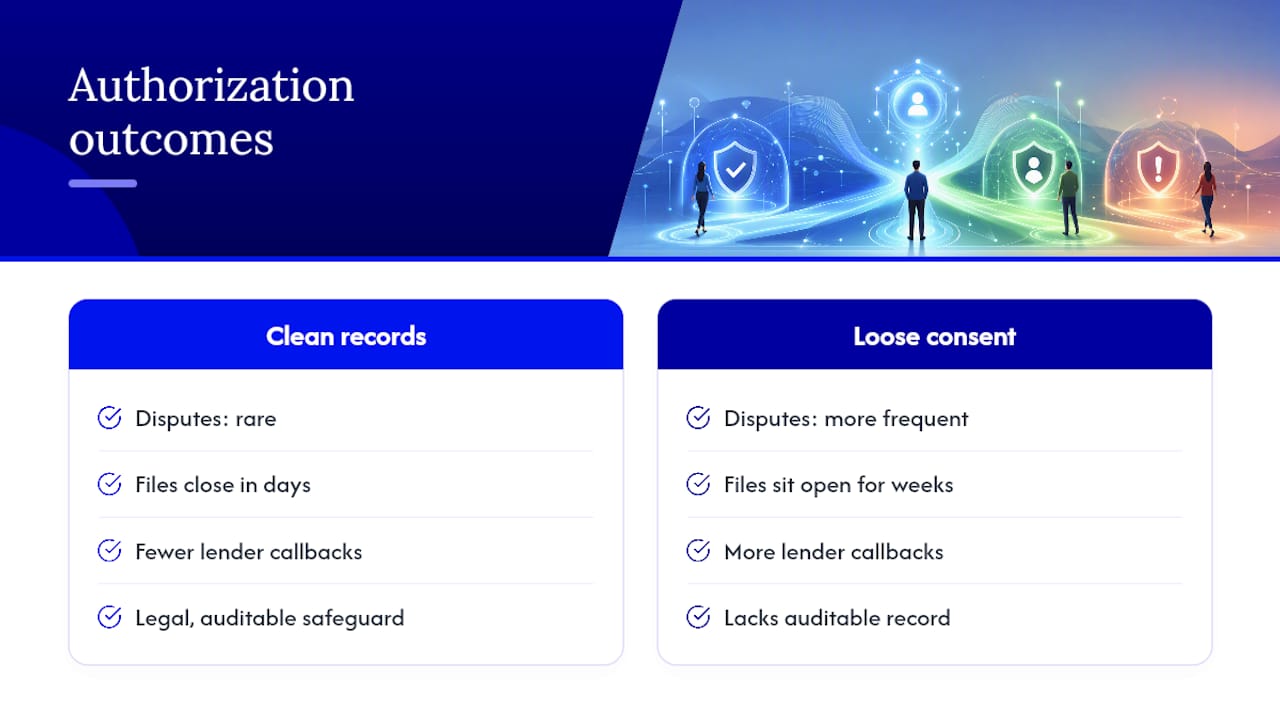
Loose consent practices cause more disputes than bad intentions do. When a broker collects a signed or e-signed authorization and files it immediately, there's rarely a question later about whether a pull was legitimate, as explained in BrokerPay's commission payment alternatives. When that step gets skipped or handled verbally, disagreements drag on and files that could have closed in days sit open for weeks.
Auditable records aren't just a legal safeguard, they speed up the whole transaction. A documented compliance process around consumer reports means fewer callbacks from lenders asking "did you actually get permission for this?" For brokers building a real pipeline, that habit compounds. Every clean file makes the next one easier to defend if a borrower ever questions how their credit was used.
— Theron
Where to Verify These Rules Yourself
- CFPB: Who can request to see my credit report explains permissible purposes in plain language.
- FTC's Fair Credit Reporting Act text covers the full statute and disclosure rules.
- IRS FCRA disclosure and authorization form shows a real, government-used sample authorization.
- eForms consent template offers a practical form layout to compare against anything you're asked to sign.
Brokers who want their own intake and authorization paperwork organized in one place, rather than scattered across emails and signed PDFs, can see how BrokersConnect handles deal documentation and lender matching from a single dashboard.
This article is general information, not a substitute for advice from a qualified financial advisor. Consult a qualified financial professional about your own circumstances before acting on anything here.
Sources
- Who can request to see my credit report? — CFPB
- Fair Credit Reporting Act (Revised March 2026) — FTC
- Disclosure and Authorization Pertaining to Consumer Reports Pursuant to the Fair Credit Reporting Act — IRS