
Start at BiggerPockets, r/CommercialRealEstate, and Mortgage Discussions for daily deal talk, and check CRE Finance Council forums if you want vetted, institution-level discussion. Public forums are free and open, best for quick questions and market color. Member-only networks like CREFC require verification but reward you with higher-trust conversations among lenders, servicers, and CMBS investors.
TL;DR:
- Public forums are useful for quick market sentiment insights and general deal discussions, but they lack the confidentiality needed for submitting sensitive documents.
- Verified, member-only forums like CRE Finance Council provide higher-trust environments ideal for discussing institutional standards, policies, and complex regulatory issues.
- When selecting a forum, verify recent activity, ensure the audience works in commercial lending, and assess moderation quality before investing time.
- Building credibility requires posting detailed, sourced questions and answering others’ technical inquiries, which enhances reputation over time.
- Platforms like BrokersConnect fill the gap by offering verified lender matching and secure deal submission, complementing open forum discussions.
Table of Contents
- 1. Active public forums worth joining today
- 2. Professional and members-only forums for higher-trust discussion
- 3. How to pick the right forum for what you actually need
- 4. Best practices for posting technical questions and building a reputation
- 5. When a dedicated broker platform fills the gaps forums leave open
- 6. Why the best brokers use both public forums and vetted networks
- A private alternative when forums aren't enough
- Sources
- FAQ
1. Active public forums worth joining today
Public forums are the fastest way to see how other brokers talk about deals, fees, and lender behavior in real time. Each one has a different personality, so match the forum to what you actually need answered.
BiggerPockets hosts some of the busiest lender and broker threads in commercial real estate, including candid comparisons of broker versus direct lender outcomes. It works well for deal troubleshooting and general CRE questions, and its lenders and brokers subforum tends to reward posts that include a clear deal summary and specific underwriting assumptions.
Reddit's r/CommercialRealEstate is looser and faster. Posts skew toward market sentiment, rate speculation, and quick sanity checks rather than deep underwriting threads, which makes it a good pulse check but a weaker source for technical detail.
Mortgage Discussions leans more procedural, with threads focused on underwriting, broker fees, and lender tradeoffs. It's a reasonable stop if you want crowd-sourced opinions on fee structures or how a particular lender handled a file, though regulatory claims there deserve independent verification.
LinkedIn groups and Alignable round out the list. They move slower than the forums above, but the professional context tends to filter out noise and produce more useful referral conversations.
- BiggerPockets: best for deal troubleshooting and broad CRE topics, high post volume.
- r/CommercialRealEstate: best for quick market sentiment and informal peer takes.
- Mortgage Discussions: best for underwriting and fee-related questions.
- LinkedIn groups and Alignable: best for professional networking and referral building.
Before posting anywhere, check for recent activity in the last week, look for a visible moderator, and read a few threads to gauge whether replies come from practitioners or just other people asking questions.
2. Professional and members-only forums for higher-trust discussion
Public forums are open to anyone, which is exactly why some conversations need a narrower room. CRE Finance Council runs multiple constituency-specific forums covering alternative lenders, CMBS investors, portfolio lenders, and servicers, each built around a verified membership roster rather than open sign-up.
That structure matters when the conversation involves market standards, policy positions, or institution-level problem solving instead of a quick underwriting question. You won't find casual deal-help threads there, but you will find people who set the rules other lenders eventually follow.
- Membership generally requires an application and verification tied to your firm or role.
- Access is organized by constituency, so a portfolio lender forum looks different from a CMBS investor forum.
- The CREFC membership page outlines requirements and typically involves an annual cost.
If your questions are about specialized deal types, regulatory direction, or getting in front of institutional lenders rather than solving one file, the membership fee usually pays for itself in access alone.
3. How to pick the right forum for what you actually need
Not every forum deserves the same amount of your time. Before you invest energy building a presence somewhere, run through a short checklist.
- Check audience fit. Confirm the forum's regular members actually work in commercial lending, not residential mortgages or general real estate investing.
- Look for active moderation. A visible moderator enforcing anti-solicitation rules is a sign the community protects its own quality.
- Confirm recent activity. Threads with replies in the past few days beat a forum with a large archive but no current conversation.
- Weigh confidentiality needs. Public forums are fine for general questions, but never a place to post identifiable deal documents.
- Compare membership cost against access. A paid, vetted forum is worth it only if it gets you closer to lenders or information you can't get elsewhere.
Good posts get detailed, sourced replies and get corrected by moderators when someone strays into bad advice. That's a healthy sign. Threads full of vague replies or repeated self-promotion usually mean the forum has decayed into a lead-generation board.
Pro Tip: Pick one goal, post a specific test question in your top candidate forum, and judge the forum by the quality of the replies before committing more time to it.

4. Best practices for posting technical questions and building a reputation
The forums that reward you long term are the ones where you show up as useful, not just as someone looking for a favor. That starts with how you frame a question.
When you post a deal summary, include the property type, loan amount range, leverage, and the specific underwriting question you're stuck on. Redact the borrower's name, exact address, and any figures that could identify the deal to someone who knows the market.
- Include enough detail (property type, loan amount, leverage) for a real answer, never enough to identify the parties.
- Move to private messages only after you've verified the other person's firm and role, and never send full loan documents over a public channel.
- Answer other people's questions before asking your own, since reputable communities reward technical contributions over pitches.
Pro Tip: Post one detailed, well-sourced answer to someone else's question before you ever ask your first one. It does more for your credibility than a dozen introductory posts.
5. When a dedicated broker platform fills the gaps forums leave open
Forums are excellent for open discussion, but they were never built for confidential deal submission or verified lender introductions. That's the gap a platform like BrokersConnect is built to close.
- AI-powered lender matching against a database of verified lenders across major CRE asset classes and loan types.
- A deal pipeline CRM and secure document vault for submissions that shouldn't live in a public thread.
- A broker community built specifically for confidential networking, alongside a lender responsiveness leaderboard.
Public forums remain the right place for market chatter and quick opinions. When the conversation turns into an actual submission, a platform built for verified matching and secure documents protects both your deal and your client's information.
6. Why the best brokers use both public forums and vetted networks
Public forums are where you learn fast: market sentiment, fee benchmarks, and how other brokers handle tricky files. Vetted professional networks and dedicated platforms are where you actually close, because they protect confidentiality and connect you to verified counterparts. Licensing and fee disclosure deserve the same caution in both settings: never take forum consensus as a substitute for checking your state's requirements.
— Theron
A private alternative when forums aren't enough
BrokersConnect gives you AI lender matching, a verified lender database, and secure deal submission in one place, useful when a forum thread isn't the right venue for a live deal.
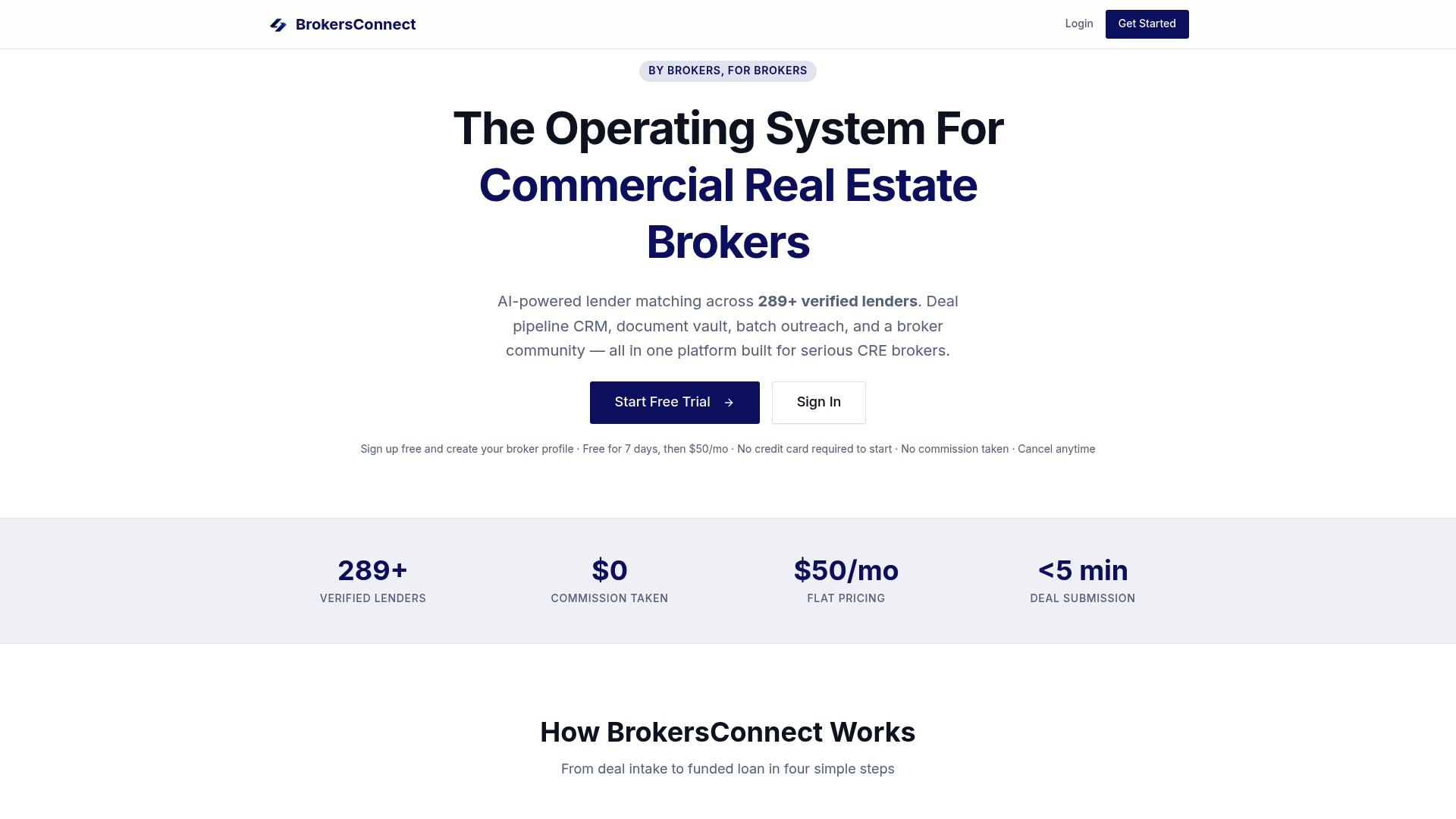
- Public forums stay useful for market talk and quick questions, and BrokersConnect fits in when a deal needs verified lenders and confidential handling instead of an open thread.
- It runs on a flat monthly subscription with a free trial, no commissions or transaction fees.
Start a free trial at BrokersConnect and see how lender matching works on your next deal.
Sources
- Speaking with a mortgage lender — BiggerPockets forums
- CRE Finance Council forums overview
- Commercial Mortgage Broker License Requirements by State - LegalClarity
- How loan professionals get paid — PG Strategic
FAQ
How much does a mortgage broker make on a $500,000 loan?
Commercial broker fees commonly run around 1% of the loan amount at close, with variations by deal size; fees may be borrower-paid, lender-paid, or split, so the engagement letter matters more than any rule of thumb. Fees may be borrower-paid, lender-paid, or split, so the engagement letter matters more than any rule of thumb.
Why use a commercial mortgage broker?
Brokers give borrowers access to multiple lenders at once instead of one direct relationship, and they can navigate complex deal situations that a single lender might decline outright. That access often matters more on unusual property types or credit profiles than on straightforward deals.
What is the 3 7 3 rule for a mortgage?
Definitions of this rule vary across sources and it's more commonly discussed in residential mortgage contexts than commercial lending. Commercial brokers are better served checking their state's specific licensing and disclosure requirements directly.
How much do commercial loan brokers charge?
Commercial loan broker fees typically land around 1% of the loan amount, though the arrangement varies by deal size and whether the borrower or lender pays. Always confirm the fee structure in a written engagement letter before the deal moves forward.
Are commercial mortgage brokers required to be licensed?
Licensing requirements are set at the state level and vary significantly, and the federal SAFE Act generally doesn't cover purely commercial brokers the way it covers residential originators. Confirm your specific state's rules with its regulator rather than relying on forum discussion alone.