
Yes, cold B2B email is legal in the United States under the CAN-SPAM Act, but it comes with specific requirements: honest headers, a valid postal address, and a working opt-out honored within 10 business days. Texts and automated messaging bring additional TCPA consent rules, and emailing contacts in the European Union pulls GDPR into the picture.
TL;DR:
- CAN-SPAM penalties can reach $53,088 per email, and both the promoted business and its third party sender may face liability.
- Email consent does not authorize automated texts; gateways can trigger TCPA rules, which require written consent for telemarketing texts and immediate action on stop requests.
- For EU contacts, document legitimate interest by assessing purpose, necessity, and recipient impact; German prospects may warrant exclusion or warmer channels under stricter rules.
- Keep the unsubscribe mechanism active for at least 30 days, sync opt outs across campaigns immediately, and timestamp every request.
Table of Contents
- 1. CAN-SPAM Act: what U.S. senders must include and how to operationalize it
- 2. TCPA and email-to-text: when outreach triggers stricter consent rules
- 3. GDPR and emailing EU contacts: legitimate interest, documentation, and immediate objection handling
- 4. Operational compliance checklist and message elements to apply before every campaign
- 5. Technical deliverability and authentication that support legal compliance and inbox placement
- 6. Recordkeeping, vendor oversight, and audit readiness for cold email programs
- 7. BrokersConnect perspective: compliance as part of disciplined lender outreach
- 8. How BrokersConnect helps brokers run targeted, compliant outreach at scale
- FAQ
- Sources
1. CAN-SPAM Act: what U.S. senders must include and how to operationalize it
The CAN-SPAM Act is the federal law that governs commercial email in the United States, and it does not require prior consent before you send a cold B2B message. That surprises a lot of sales teams used to thinking in GDPR terms. Instead of an opt-in requirement, the law sets a baseline of honesty and an easy way out for recipients who don't want to hear from you again.
Every commercial email needs to meet a short list of conditions, and each one translates into something a campaign owner can check before hitting send:
- No false or misleading headers. Your "From," "To," and routing information must accurately identify who sent the message.
- Truthful subject lines. The subject has to reflect what's actually inside the email, not a curiosity hook that misrepresents the content.
- Clear identification as an ad when the primary purpose of the message is promotional.
- A valid physical postal address. A street address, a USPS-registered PO box, or a registered private mailbox all satisfy this.
- A working opt-out mechanism that stays functional for at least 30 days after the message is sent, with no fee or extra personal information required to use it.
The opt-out piece has a hard deadline attached to it. Once someone unsubscribes, you have 10 business days to stop emailing them, and that clock applies regardless of how your outreach is routed through a vendor or shared inbox. The FTC has also clarified that this protection extends to customers and subscribers, so even a membership newsletter needs a working unsubscribe link once its primary purpose turns commercial, according to the FTC's own guidance.
Penalties for getting this wrong can be severe. The FTC can seek up to $53,088 per violation, and that figure applies per email, not per campaign, which means a single bad blast to a few thousand contacts can generate exposure well into the millions on paper.
Liability isn't limited to the company whose product is being advertised, either. The statute itself extends to third-party senders, meaning an outsourced SDR team or a marketing agency sending on your behalf can also be held responsible for violations, and so can you as the business whose offer is being promoted. CAN-SPAM generally preempts state laws that regulate email content directly, but state claims grounded in fraud, deception, or forgery can still proceed alongside a federal case, according to a Cornell Law explanation of the preemption doctrine. That combination, a federal penalty structure plus a narrow opening for state litigation, is why sloppy header practices or ignored opt-outs carry more risk than most sales teams assume.
Courts have also weighed in on what counts as "materially false or misleading" when it comes to header information. The Ninth Circuit has held that header alterations matter when they impair a recipient's ability to identify or respond to the actual sender, while a technically accurate "From" line is less likely to trigger liability absent evidence of false pretenses, based on a Ninth Circuit opinion interpreting the statute. In practice, that means using a real company domain and a reply address that actually reaches a human does most of the work of staying on the right side of this requirement.
2. TCPA and email-to-text: when outreach triggers stricter consent rules
The Telephone Consumer Protection Act doesn't apply to a standard cold email sitting in someone's inbox. It governs phone calls and text messages, specifically those sent through autodialers or involving prior express written consent for telemarketing texts, according to an FCC advisory on the subject. The distinction matters because a lot of outreach tools blur the line between email and SMS without sales teams realizing it.
The risk shows up in a few common scenarios:
- Email-to-text gateways. Routing a message through a carrier's email-to-SMS address turns an email into a text message, and the FCC has signaled that these gateways can be treated as autodialers for TCPA purposes.
- Autodialed texts built from email lists. If you pull a contact's mobile number from an email signature and feed it into an automated texting tool, you've likely triggered a consent requirement that your email list never had.
- Revocation requests. Once someone asks to stop receiving texts, that request needs to be honored immediately and documented, since TCPA enforcement treats ignored revocations as a serious violation.
The safest practical stance is to keep email and SMS channels separate unless you have documented, written consent specifically for automated text outreach. Don't assume that because someone didn't object to an email, they've agreed to a text. Treat any opt-out or "stop" reply as final, and keep a timestamped record of it the same way you would a CAN-SPAM opt-out.
3. GDPR and emailing EU contacts: legitimate interest, documentation, and immediate objection handling
If your outreach ever touches a contact based in the European Union, even a routine B2B cold email, GDPR treats that person's work email address as personal data the moment it identifies them. That's a different starting point than CAN-SPAM, which focuses on message content rather than the data itself.
Most B2B senders rely on "legitimate interest" as their legal basis for cold outreach rather than seeking prior consent for every message. A 2026 synthesis of CAN-SPAM, GDPR, and CASL notes that this is the commonly used path for B2B cold email under GDPR, but it isn't a blanket excuse to email anyone whose address you can find. Before relying on legitimate interest, assess whether the outreach has a genuine business purpose, whether email is necessary, and whether your interest outweighs the recipient's.
- Purpose: Is there a genuine business reason for contacting this specific person about this specific offer?
- Necessity: Is email actually necessary to achieve that purpose, or could you reach the same goal with less intrusive means?
- Balancing: Does your interest in reaching out outweigh the recipient's interest in not being contacted, given their role and the context?
Documenting that assessment before you send, not after a complaint arrives, is what turns legitimate interest from a theory into a defensible position. Keep a written record of why you concluded the outreach was appropriate for that segment of contacts.
Pro Tip: Build your legitimate interest assessment into your campaign setup process, not as an afterthought. A one-page template per campaign, covering purpose, necessity, and balancing, can document your assessment if a regulator ever asks.
Objections carry real weight under GDPR. If a recipient invokes their right to object under Article 21, stop processing their data for direct marketing and check the applicable official guidance on how promptly to act. A practical 2026 compliance overview recommends same-day suppression across jurisdictions as the safest default, since trying to apply different timelines to different regions invites mistakes.
Some EU member states layer additional restrictions on top of GDPR. Germany's UWG (Unfair Competition Act) is often cited as stricter than the general GDPR framework for unsolicited commercial communication, and the same 2026 overview suggests either excluding German prospects from cold email campaigns entirely or routing that outreach through warmer channels like LinkedIn or referral introductions instead.
4. Operational compliance checklist and message elements to apply before every campaign
Treating compliance as a one-time legal review misses the point. It's an operational habit that needs to show up at each stage of a campaign: before you send, inside the message itself, and after the send goes out.
Pre-send:
- Validate the source of every contact list and avoid purchased or scraped data sets with no documented origin.
- Record how and when each contact's information was acquired, since that provenance record becomes your evidence if a complaint surfaces later.
- Suppress anyone on a public do-not-contact registry and cross-reference your internal opt-out list before the first email goes out.
Per-message:
- Use an accurate "From" name and a "Reply-To" address that actually reaches a person who can respond.
- Write subject lines that reflect the email's real content.
- Label the message as an advertisement when its primary purpose is promotional.
- Include a physical postal address in the footer, whether that's a street address, a USPS-registered PO box, or a registered private mailbox.
- Add a one-click unsubscribe link alongside a List-Unsubscribe header so recipients can opt out without extra steps.
A simple footer line like "You're receiving this because [reason for contact]. Unsubscribe here. [Company name], [postal address]" covers the disclosure and opt-out requirements in a single sentence without cluttering the message.
Post-send:
- Honor every opt-out within 10 business days of the request, and aim for same-day processing wherever your tooling allows it.
- Update your suppression list immediately so no other campaign or sequence accidentally re-contacts someone who already opted out.
- Log each opt-out event with a timestamp, since that log is what you'll produce if your compliance is ever questioned.
- Escalate spam complaints to a human reviewer and remove repeat complainers from all active lists, not just the campaign that triggered the complaint.
Pro Tip: A one-click unsubscribe does more than satisfy the letter of the law. It reduces spam complaints because recipients who can leave easily are far less likely to hit "report spam" instead, and that complaint rate directly affects whether your future emails land in the inbox or the junk folder.
Brokers running sequences against lender lists face the same operational demands as any other cold outreach program. A cold email sequence built for reaching lenders still needs the same suppression logic and opt-out handling baked into every touch, not just the first one.

5. Technical deliverability and authentication that support legal compliance and inbox placement
Legal compliance and inbox placement aren't separate problems. The technical infrastructure behind your email, specifically SPF, DKIM, and DMARC, exists to prove your messages are genuinely coming from you, and that authentication record becomes evidence if anyone ever disputes who sent a given email.
- SPF (Sender Policy Framework) tells receiving mail servers which IP addresses are authorized to send email on behalf of your domain, which helps prevent spoofing.
- DKIM (DomainKeys Identified Mail) attaches a cryptographic signature to each outgoing message, so the receiving server can verify the content wasn't altered in transit.
- DMARC (Domain-based Message Authentication, Reporting, and Conformance) ties SPF and DKIM together and tells mailbox providers what to do with messages that fail those checks, while also generating reports you can review.
These authentication records matter for a header dispute under CAN-SPAM specifically because they create a technical paper trail showing your domain, not an impersonator, sent the message in question. If a recipient claims your "From" address was spoofed or misleading, a clean DMARC report is one of the clearest ways to demonstrate otherwise.
The List-Unsubscribe header works alongside your visible unsubscribe link to give mailbox providers like Gmail and Outlook a standardized way to offer one-click opt-out directly in their interface. A 2026 compliance guide notes that one-click unsubscribe and same-day suppression are considered best practice precisely because they protect deliverability, not just legal standing.
Monitoring your sending reputation matters as much as the initial setup. Complaint rates, bounce patterns, and authentication failures all show up in postmaster tools that major mailbox providers offer, and those technical logs double as evidence of good-faith compliance efforts if your program is ever scrutinized. A sender who can point to consistently low complaint rates and a clean DMARC history has a much easier time defending their practices than one who can't produce any monitoring data at all.
6. Recordkeeping, vendor oversight, and audit readiness for cold email programs
Good recordkeeping is what separates a defensible compliance program from one that only looks good until someone asks a question. The records worth keeping include:
- Opt-out logs with exact timestamps showing when a request came in and when it was processed.
- Data source documentation describing how and where each contact's information was acquired.
- Legitimate interest assessments for any EU contacts, covering the purpose, necessity, and balancing test described earlier.
- Suppression files synced with internal do-not-contact lists and any relevant public registries.
Vendor oversight deserves the same rigor if you're using a third-party platform or outsourced SDR team to send on your behalf. Contract language that preserves your right to audit a vendor's sending practices, combined with service-level agreements specifying how quickly they process opt-outs, closes a gap that a lot of companies discover too late. It's worth periodically testing a vendor's own unsubscribe flow yourself, the same way you'd test any other part of your stack, to confirm it actually works rather than assuming it does.
Retention periods don't need to be indefinite, but keeping these records for at least a few years gives you something to produce if a regulator inquiry or a litigation demand ever arrives. A commercial mortgage compliance playbook built for CRE brokers makes a similar point: documentation that feels like overhead in the moment is what protects you later, and it rarely costs more than a few minutes of setup per campaign.
7. BrokersConnect perspective: compliance as part of disciplined lender outreach
Brokers who treat lender outreach as a volume game eventually pay for it in complaint rates, damaged sender reputation, and lenders who stop opening their emails entirely. We see compliance less as a legal checkbox and more as the foundation of outreach that actually gets responses, because a lender who trusts your sender reputation is more likely to open the next message too.
That's part of why batch outreach tools need suppression logic and documented data provenance built in from the start rather than bolted on afterward. When contact data comes from a verified source and opt-outs flow into a shared suppression list automatically, brokers spend less time worrying about which lender they already contacted and more time on the deals that are actually moving.
Disciplined outreach and compliant outreach turn out to be the same habit, just described from two different angles.
— Theron
8. How BrokersConnect helps brokers run targeted, compliant outreach at scale
Running lender outreach by hand across spreadsheets and email threads makes it easy to lose track of who opted out and which contact data actually came from a reliable source. BrokersConnect brings batch lender outreach and a database of 289+ verified lenders into one place.
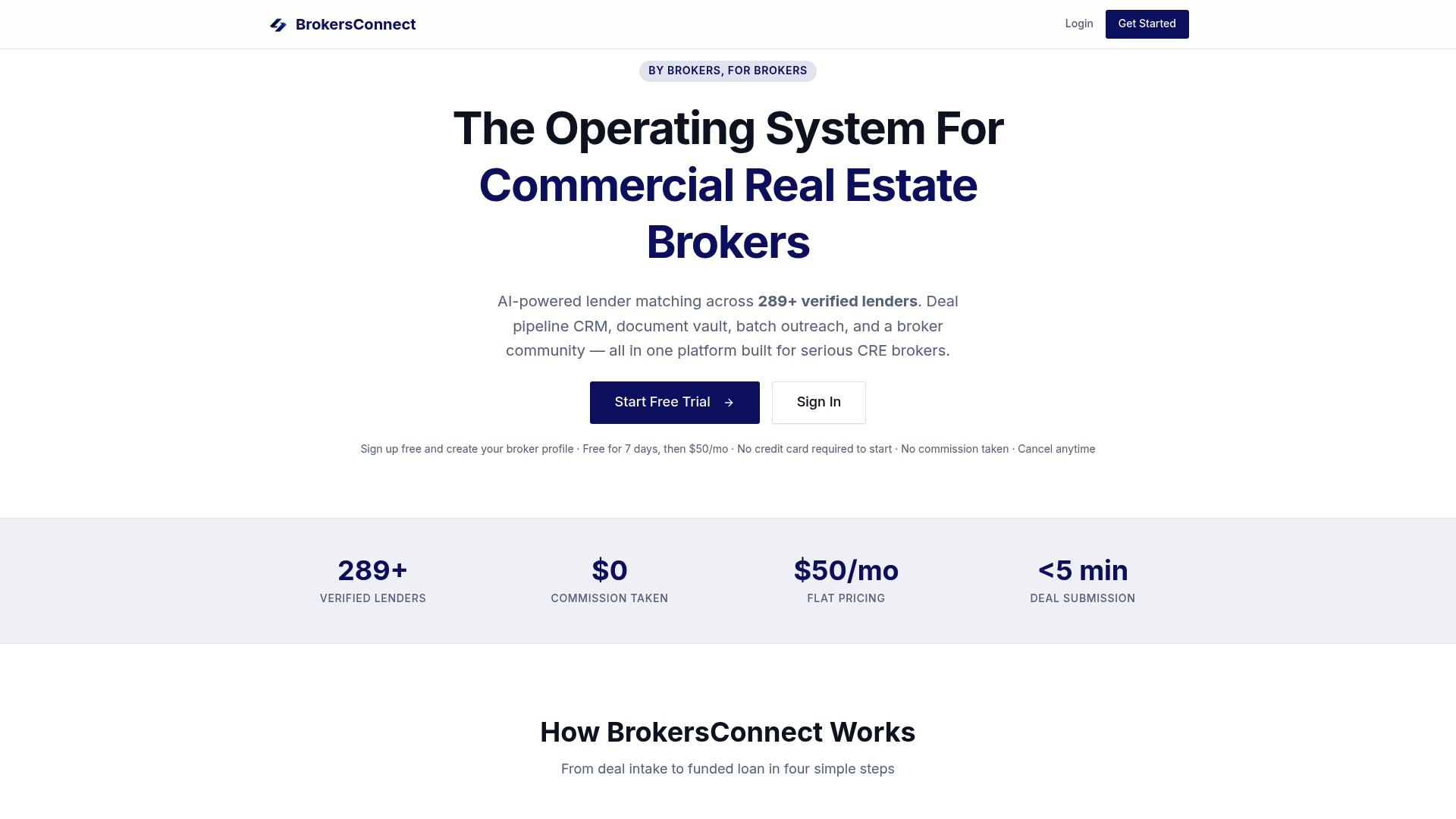
- Batch outreach helps brokers manage lender outreach.
- Central deal pipeline and document vault keep outreach, follow-up, and packaging in one workflow instead of scattered tools.
| What you get | Detail |
|---|---|
| Plan | BrokersConnect, $50 per month |
| Lender database | 289+ verified lenders across major CRE asset classes |
| Outreach tools | Batch outreach, pipeline CRM |
| Pricing model | Flat monthly fee, no commission or transaction fees |
A free trial lets you try the platform before committing to a subscription. Start your free trial on BrokersConnect and see how suppression and provenance tracking fit into your next lender outreach sequence.
FAQ
Does the TCPA apply to emails?
No, the TCPA generally does not apply to standard cold emails. It governs autodialed phone calls and text messages, so TCPA concerns only arise if an email campaign gets converted into SMS through a gateway or paired with automated texting, according to an FCC advisory.
What types of emails are covered by the CAN-SPAM Act?
CAN-SPAM covers any commercial email whose primary purpose is advertising or promoting a product or service, including cold outreach emails. The law applies regardless of whether the recipient is a subscriber or a brand-new contact, as long as the message is commercial in nature.
Can you cold email someone?
Yes, sending unsolicited commercial email to someone you have no prior relationship with is legal in the United States under CAN-SPAM, which is opt-out based rather than requiring consent beforehand. You still need honest headers, a valid postal address, and a working opt-out mechanism honored within 10 business days.
What are the laws governing email marketing in the United States?
The CAN-SPAM Act is the primary federal law, requiring truthful sender and subject information, clear ad disclosure, a physical postal address, and a functional opt-out process. State laws generally can't regulate email content directly because CAN-SPAM preempts them, though state claims rooted in fraud or deception can still apply alongside federal enforcement.
How does GDPR affect U.S. companies emailing contacts in the EU?
GDPR treats an identifiable business email address as personal data, so U.S. senders typically rely on "legitimate interest" as their legal basis for B2B cold outreach to EU contacts. That basis requires a documented assessment and immediate action if a recipient objects to further marketing contact.