
A complete bridge loan submission needs six components: a cover sheet with deal snapshot, borrower and sponsor credentials, a documented exit plan, an independent valuation, full financials, and the required third-party reports. This checklist is built for brokers and lenders packaging bridge requests, and it reflects how underwriters actually work: asset first, exit second, stress-tested assumptions throughout.
TL;DR:
- A comprehensive bridge loan packet should prioritize an organized, clearly labeled files and include an up-to-date appraisal, environmental report, and detailed exit strategy.
- Underwriters evaluate key ratios like LTV, DSCR, and debt yield, with sensitivity analyses adding confidence in deal resilience under adverse conditions.
- Supporting documents, such as guarantor financials and title exceptions, must be complete and supported before submission to avoid delays or refusals.
- Ordering and tracking critical reports early and maintaining consistent formatting and file naming accelerates underwriting approval and reduces back-and-forth questions.
- Approvals hinge more on a well-documented exit plan and strong asset valuation than on borrower credit, with unsupported assumptions often leading to denials.
- ✓Match scenarios with verified lenders
- ✓Prepare and organize loan submissions
- ✓Track lender conversations
- ✓Manage your deal pipeline
Table of Contents
- The lender-ready document checklist, ordered and categorized
- What underwriters test: LTV, DSCR, debt yield, and tenor
- Appraisal and environmental due diligence requirements
- Documenting and stress-testing the exit strategy
- Packaging, naming, and timing the submission
- Common red flags that slow or kill approval
- What actually speeds up underwriting decisions
- Assemble your bridge loan packet faster with BrokersConnect
- FAQ
- Sources
The lender-ready document checklist, ordered and categorized
Underwriters move faster through a packet that follows their own review sequence. Lead with context, back it with numbers, close with third-party verification.
Start with a one-page cover sheet: deal snapshot (property type, loan amount, term, purpose), sponsor summary, and a contact list for the broker, borrower, and any co-sponsors. This single page often determines whether an underwriter opens the rest of the file with confidence or skepticism.
Borrower and sponsor documents:
- Entity formation documents, operating agreements, and an organizational chart showing ownership percentages.
- KYC materials: government ID, personal financial statement, and a schedule of real estate owned.
- Two to three years of tax returns for the borrowing entity and guarantors.
Property package:
- Current rent roll, lease abstracts, and a unit mix summary.
- Trailing twelve and trailing three month operating statements (T12/T3).
- Property photos, a capital improvement history, and any pending maintenance items.
Financials and pro forma:
- Historical profit and loss statements alongside a forward budget.
- A sources and uses table showing debt, equity, and any mezzanine or preferred components.
- Proof of equity: bank statements or a signed equity commitment letter.
Third-party reports:
- Appraisal or evaluation, matched to loan size and complexity.
- Phase I environmental report with signed declarations.
- ALTA title commitment, current survey, and, for rehab deals, contractor bids and permits.
Name files by date and category, such as 2026-03-14_appraisal_summary.pdf, and place a one-page index at the front listing every document and its page count. Underwriters reviewing dozens of submissions a week notice when a packet is organized this way, and it shortens the list of follow-up questions. For a deeper breakdown of document-level requirements, our loan document checklist for CRE brokers covers line items beyond the bridge-specific list here, and the standard commercial loan application overview is a useful cross-check for conventional application forms.
Pro Tip: When re-submitting an updated packet, add a one-line "what changed" note at the top so the underwriter doesn't have to re-read the whole file to find the update.

What underwriters test: LTV, DSCR, debt yield, and tenor
Bridge underwriting runs on a handful of ratios, and presenting them clearly, rather than making the underwriter calculate them, speeds approval.
- Loan-to-value (LTV) and loan-to-cost measure leverage against the as-is or as-stabilized value and total project cost, respectively.
- Debt service coverage ratio (DSCR) measures in-place or projected cash flow against debt payments.
- Debt yield divides net operating income by loan amount, giving lenders a leverage check that ignores interest rate assumptions.
- Bridge loans typically carry short tenors with extension options tied to performance milestones.
The OCC's Comptroller's Handbook on commercial real estate lending frames these metrics as the backbone of CRE underwriting standards, including sponsor equity expectations and the case for independent appraisal review. Lenders also stress-test exit valuations, applying haircuts to comparable sales and building in delayed rent-up timelines before they trust a sponsor's base case.
Sponsor equity and guarantor strength matter as much as the ratios: weak guarantor liquidity is a common reason a strong asset still gets a counteroffer instead of an approval.
Include a sensitivity table showing the deal at base, downside, and severe downside cases, even when the sponsor's numbers look solid on paper. Underwriters trust packets that show the deal survives a worse scenario, not just the best one.
Appraisal and environmental due diligence requirements
Valuation and environmental review are where bridge submissions most often stall, usually because the reports arrive stale or incomplete.
- An appraisal is generally required for larger or more complex transactions; a narrower evaluation may suffice for smaller, lower-risk deals, subject to the lender's policy.
- Interagency appraisal guidance requires independence in the appraisal program, meaning the broker or borrower cannot select or pressure the appraiser.
- Phase I reports must meet EPA's All Appropriate Inquiries standards, including signed declarations and disclosed data gaps from the environmental professional.
- Phase I reports have a limited shelf life; components nearing or past typical validity windows often need updating or a fresh site visit before underwriting can proceed.
Pro Tip: Order the Phase I report early and track its date against your expected closing timeline. A report that expires mid-underwriting forces a costly re-inspection right when momentum matters most.
Documenting and stress-testing the exit strategy
A credible exit is specific, not aspirational. Underwriters want to see the mechanism, not just the intention.
- Write a concise exit statement naming the timing, the likely buyer or takeout lender, and the valuation assumptions behind it.
- Build a stress case with a price haircut and a delayed timeline, and show the loan still performs under those conditions.
- Attach any takeout commitment, letter of intent, or presale agreement; these materially shift an underwriter's confidence versus a stated intention alone.
- Tie the sponsor's track record and relevant comparable sales directly to the exit narrative rather than leaving the underwriter to connect the dots.
For bridge-to-permanent structures specifically, our piece on beating the six-month takeout timeline walks through how stabilization assumptions feed the exit case.
Packaging, naming, and timing the submission
A clean packet and the right report order save weeks of underwriting time.
- Scan documents at 300 DPI or higher, name files with a YYYY-MM-DD convention, and put a one-page index at the front.
- Order the appraisal, title commitment, survey, and Phase I early enough that none expires before the closing date.
- Use a secure transmission method with version control, so the underwriter is never working from an outdated draft.
Pro Tip: Keep a simple follow-up tracker logging every underwriter question, who owns the response, and the date it was sent back. For closing-stage readiness once underwriting clears, the commercial loan closing checklist picks up where this packet leaves off.
Common red flags that slow or kill approval
Most delays trace back to a handful of recurring issues, and most are fixable before submission rather than after a lender flags them.
- A stale or undated Phase I report, fixed by ordering an update before the file goes out.
- Unsupported rent-up assumptions, fixed by grounding projections in the actual rent roll analysis rather than pro forma optimism.
- An unclear source of repayment, fixed by naming the specific takeout mechanism and backup plan.
- Title exceptions left unexplained, fixed by addressing each one directly in the submission narrative.
- Missing or incomplete guarantor documentation, fixed by collecting personal financial statements before, not after, the underwriter asks.
What actually speeds up underwriting decisions
The brokers who get fast answers aren't the ones with the biggest deals, they're the ones whose packets never make an underwriter guess. A missing signature page or an undated environmental report does more damage than a thin DSCR, because it signals the whole file needs double-checking. Consistent formatting across every submission trains the underwriter to trust the next one faster.
— Theron
Assemble your bridge loan packet faster with BrokersConnect
Our platform is designed around this workflow: a secure document vault to organize borrower, property, and third-party files, lender matching to find capital sources suited to the deal's property type and leverage, and pipeline tracking so nothing slips between submission and response.
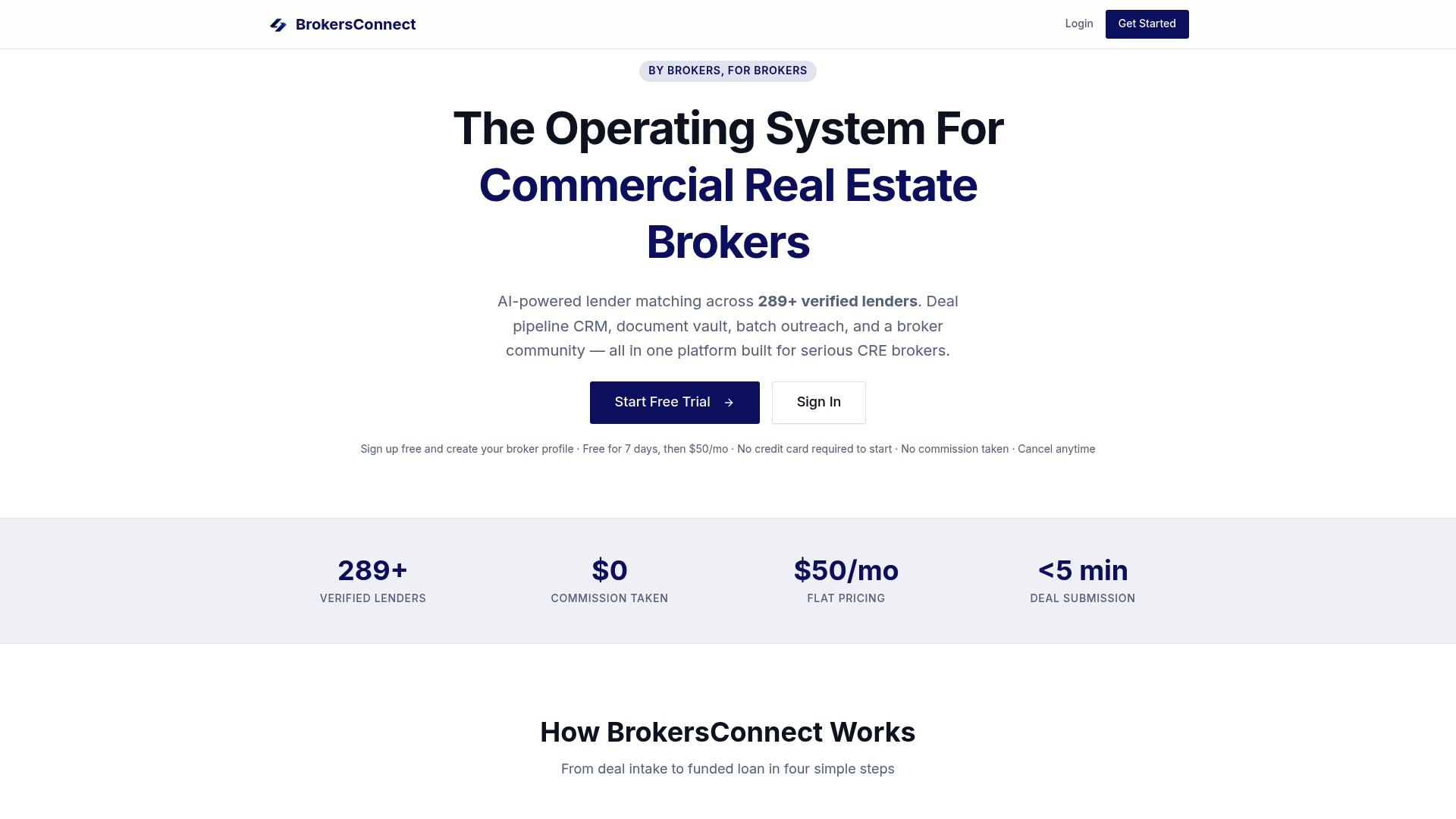
Instead of rebuilding a checklist from scratch for every deal, we provide deal templates and information on lender responsiveness that helps brokers see who actually answers. Start a free trial on the BrokersConnect platform and move your next bridge submission through underwriting with less back-and-forth.
FAQ
How hard is it to get approved for a bridge loan?
Approval difficulty depends more on the strength of the exit plan and the asset's valuation than on borrower credit alone. A well-documented packet with independent appraisal, current environmental reports, and a stress-tested exit moves through underwriting far more smoothly than one missing those pieces.
What gets you denied in underwriting?
Denials most often trace to an unclear source of repayment, unsupported rent-up or exit assumptions, or missing guarantor financial documentation. Title exceptions left unaddressed and expired environmental reports also push files toward decline rather than approval.
What not to do during underwriting?
Avoid submitting an incomplete packet and letting the underwriter request missing items one at a time, since each round-trip adds delay. Don't let a Phase I report or appraisal expire mid-review, and don't leave exit assumptions undocumented.
What does Dave Ramsey say about bridge loans?
Dave Ramsey's commentary focuses on consumer and residential bridge financing rather than commercial real estate underwriting, and it is not a source for commercial bridge loan requirements. Commercial bridge underwriting standards come from lender credit boxes and guidance such as the OCC's Comptroller's Handbook, not personal finance commentary.
Sources
- Brownfields All Appropriate Inquiries | US EPA
- Commercial Real Estate Lending (Comptroller's Handbook)